 Money

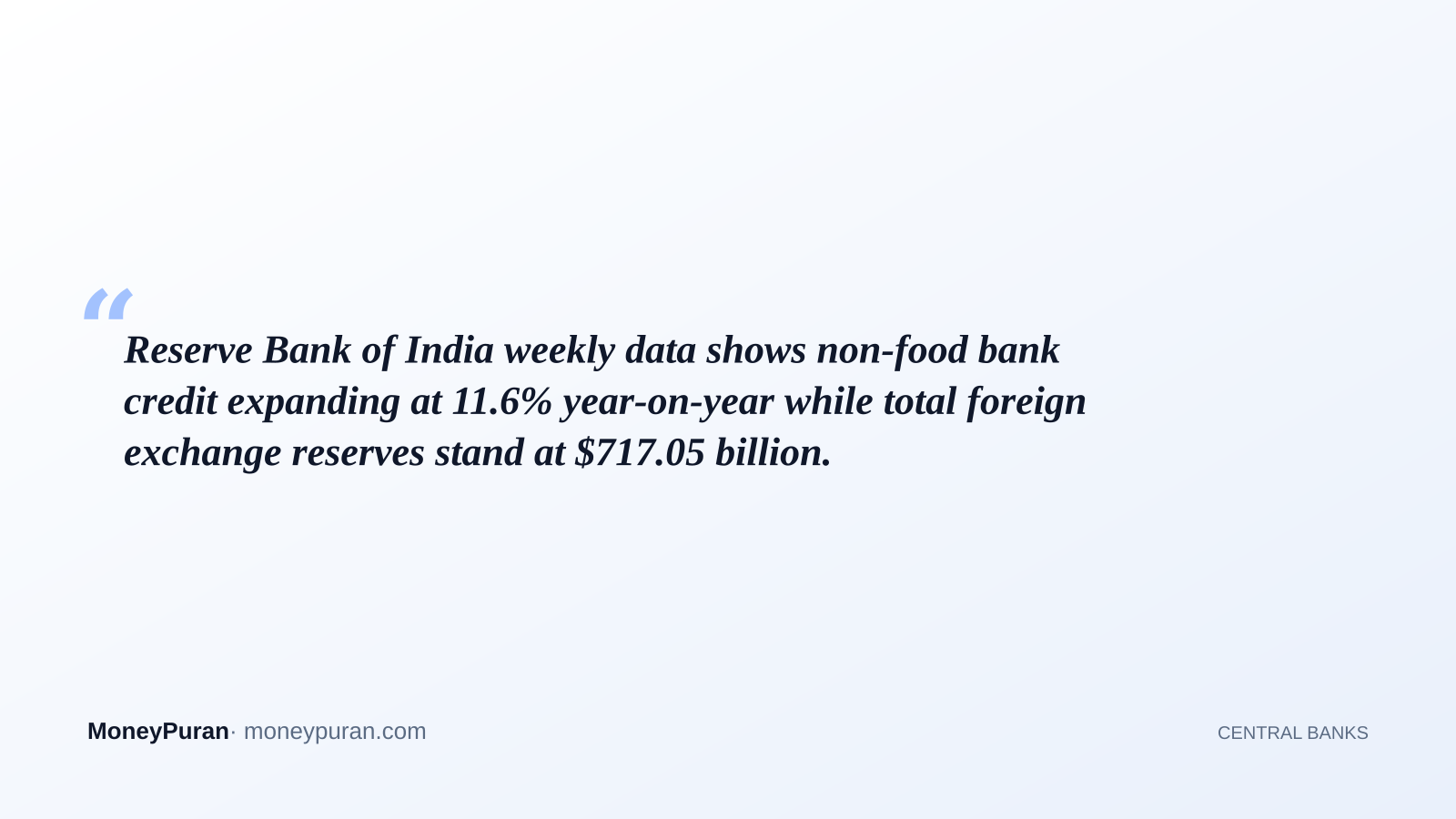
Reserve Bank of India weekly data shows non-food bank credit expanding at 11.6% year-on-year while total foreign exchange reserves stand at $717.05 billion.
Key points
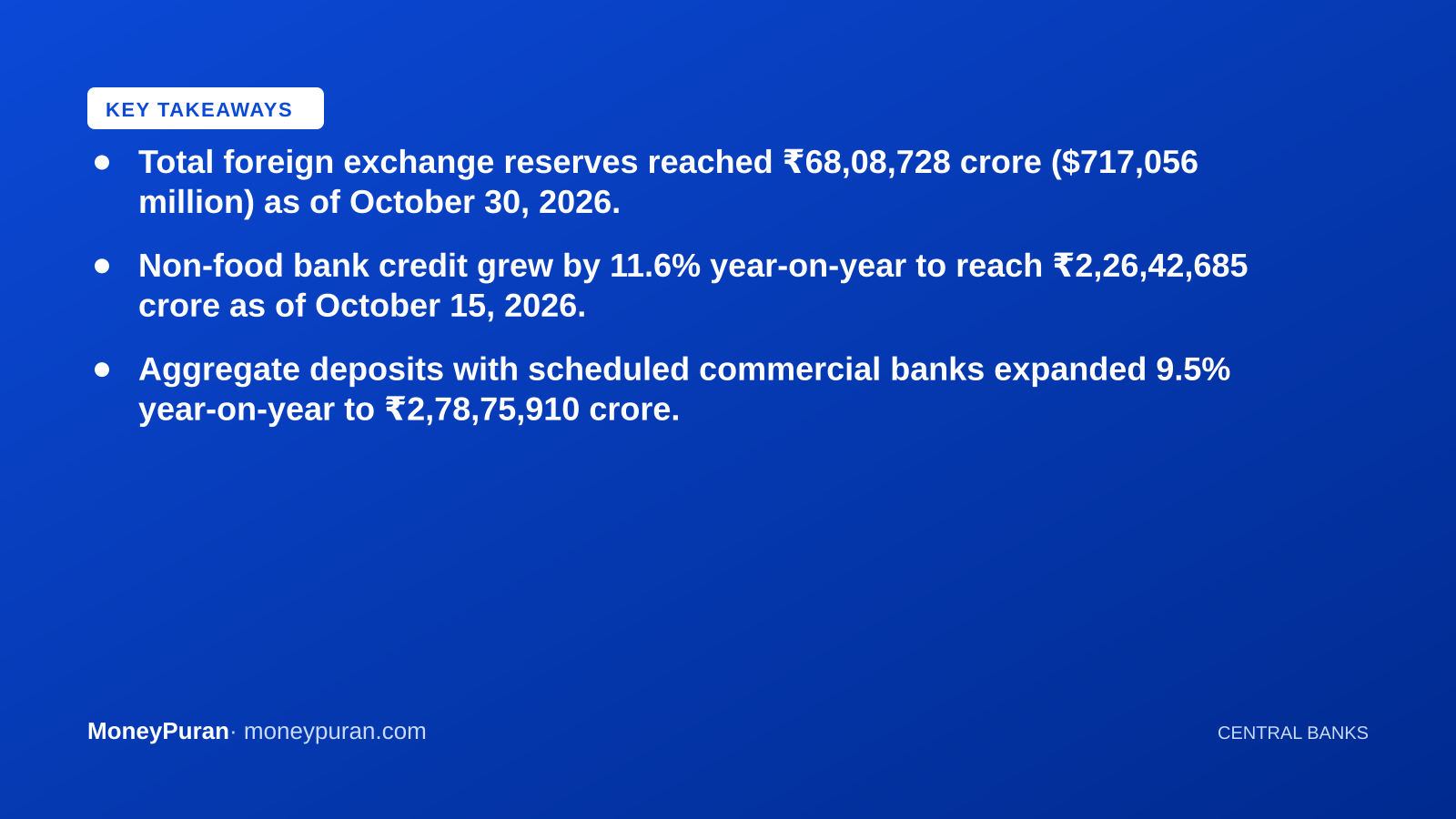
- Total foreign exchange reserves reached ₹68,08,728 crore ($717,056 million) as of October 30, 2026.
- Non-food bank credit grew by 11.6% year-on-year to reach ₹2,26,42,685 crore as of October 15, 2026.
- Aggregate deposits with scheduled commercial banks expanded 9.5% year-on-year to ₹2,78,75,910 crore.
- Broad money supply (M3) registered a 16.0% annual increase, totaling ₹3,33,00,300 crore.
The latest weekly statistical supplement released by the Reserve Bank of India (RBI) highlights steady credit expansion across scheduled commercial banks alongside robust foreign exchange reserves. According to the central bank data, non-food bank credit registered an 11.6% growth rate over the financial year, demonstrating sustained demand for financing from commercial and retail sectors. At the same time, India’s foreign exchange chest remained fortified at over $717 billion, providing a substantial cushion against external volatility.
Scheduled commercial banks reported aggregate deposits touching ₹2.78 crore crore as of mid-October 2026, marking a 9.5% increase compared to the previous year. Time deposits continued to capture the lion’s share of savers’ allocations, reflecting prevailing interest rate preferences across retail depositors. Meanwhile, broad money supply indicators (M3) tracked by the monetary authority expanded by 16.0% on a year-on-year basis, moving in tandem with broader economic activity.
Foreign Exchange Reserves and Liquidity Management
The RBI report positioned total foreign exchange reserves at ₹68,08,728 crore, equivalent to $717,056 million as of October 30, 2026. Foreign currency assets, the largest component of the reserves, stood at $591,118 million. Gold reserves accounted for $102,591 million of the total kitty. Daily liquidity operations during late October reflected active management by the central bank, with standing deposit facility absorption frequently offsetting systemic fluctuations and variable rate repo deployments maintaining balanced short-term funding conditions.
What this means for investors
For Indian investors, the RBI’s weekly update offers crucial visibility into banking sector liquidity, credit off-take, and monetary expansion. Robust double-digit credit growth signals that underlying economic demand remains intact, which generally translates to healthy core operational metrics for major commercial lenders. However, it also underscores the ongoing battle for deposits as banks compete for funds to support loan books.
A strong foreign exchange reserve position acts as a vital macroeconomic stabilizer for Indian markets, shielding the rupee against sudden global capital outflows or commodity price shocks. Investors tracking banking stocks, fixed-income yields, and currency trends should monitor these bi-weekly monetary aggregates to gauge systemic liquidity tightness and credit velocity.
Frequently asked questions
Question? What does non-food credit growth indicate for the economy?
Answer. Non-food credit measures loans extended by banks to individuals and businesses for productive economic activities, excluding food procurement operations, serving as a primary gauge of private sector borrowing demand.
Question? How does the RBI manage banking system liquidity?
Answer. The central bank utilizes tools like the Liquidity Adjustment Facility, standing deposit facilities, and variable rate repos to inject or absorb funds, ensuring overnight interest rates align with monetary policy goals.
This article is for information only and is not investment advice. Do your own research or consult a licensed adviser before investing.
Based on information published by Reserve Bank of India (RBI). Source: Reserve Bank of India (RBI). Spotted an error? corrections@moneypuran.com