 Money

Regulators allege foreign-operated entities used false SEC filings and fake seals to raise $130 million in a Ponzi-like crypto scheme.
Key points
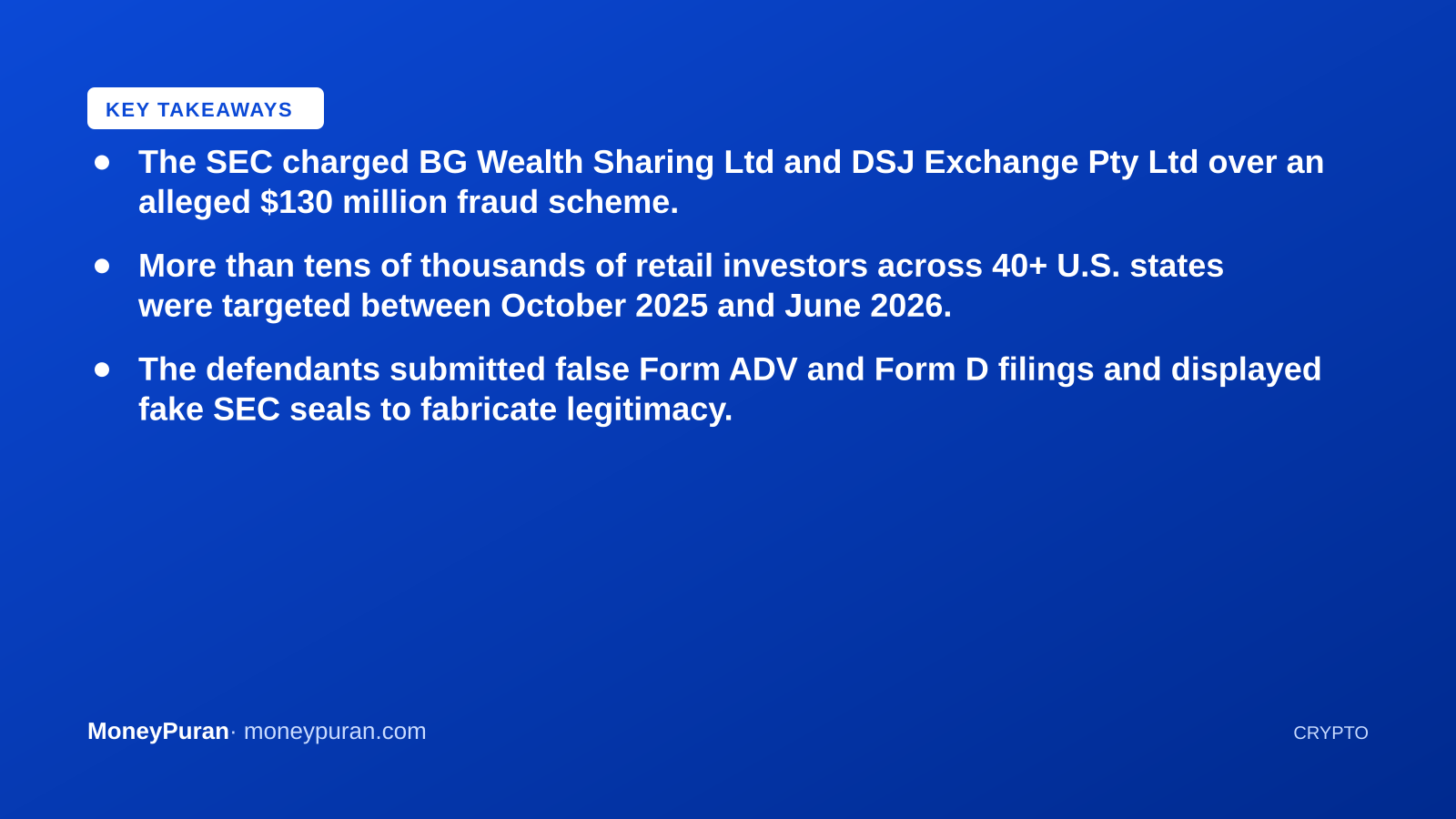
- The SEC charged BG Wealth Sharing Ltd and DSJ Exchange Pty Ltd over an alleged $130 million fraud scheme.
- More than tens of thousands of retail investors across 40+ U.S. states were targeted between October 2025 and June 2026.
- The defendants submitted false Form ADV and Form D filings and displayed fake SEC seals to fabricate legitimacy.
- The enforcement action seeks permanent injunctions, civil penalties, and disgorgement in federal court.
The U.S. Securities and Exchange Commission has filed fraud charges against two foreign-operated entities that orchestrated a $130 million SEC crypto fraud targeting tens of thousands of retail investors. Regulators alleged that BG Wealth Sharing Ltd and DSJ Exchange Pty Ltd misled investors by fabricating regulatory documents and promising risk-free crypto trading returns.
Anatomy of a $130 million crypto scheme
According to the SEC complaint filed in the U.S. District Court for the Northern District of California, the alleged scheme ran from October 2025 to June 2026. The two Colorado-incorporated entities solicited funds from retail investors spanning more than 40 U.S. states and several territories. Promising extraordinary returns, the operators claimed their strategy relied on specialized signals for crypto asset trading.
To convince investors, BG Wealth falsely portrayed itself as the world’s largest hedge fund and an SEC-registered investment adviser. The firm claimed a partnership with DSJ Exchange, which it presented as a fully licensed and secure crypto trading platform. However, enforcement officials confirmed that these representations were completely false.
How fake SEC filings were used to build trust
The alleged perpetrators used multiple communication channels to maintain investor engagement, including encrypted messaging platforms, social media, weekly live videoconferences, and a custom mobile application. To project an image of regulatory compliance, the entities submitted false Form ADV and Form D filings to the SEC. These public filings were then shown to prospective victims as proof of official registration.
The SEC noted that the defendants displayed fake certificates bearing the official SEC seal and operated a Ponzi-like model by paying periodic returns to earlier investors while misappropriating the remaining capital. Regulators have since removed the fraudulent Form ADV and Form D filings from the SEC official website and issued investor alerts regarding the misuse of public regulatory database filings.
Key details of the SEC enforcement action
The legal action targets violations across multiple federal securities statutes and seeks severe civil remedies:
- Defendants: Foreign-operated, Colorado-incorporated entities BG Wealth Sharing Ltd and DSJ Exchange Pty Ltd.
- Total Funds Involved: Over $130 million raised from tens of thousands of retail investors.
- Statutes Violated: Antifraud provisions of the Securities Act of 1933, the Securities Exchange Act of 1934, and Sections 204(a) and 207 of the Investment Advisers Act of 1940.
- Relief Sought: Permanent injunctions, disgorgement of illicit gains with prejudgment interest, civil monetary penalties, and conduct-based injunctions.
What this means for investors
This case highlights how fraudsters leverage public filing systems and regulatory branding to manufacture false credibility. Simply appearing in a public regulatory database or showing a document with an official agency seal does not mean a financial firm or investment adviser is vetted, approved, or legally authorized to guarantee returns.
For investors in India and worldwide, cross-border crypto scams operating through social media and messaging channels present growing risks. Indian retail market participants who explore foreign platforms must remember that guaranteed, risk-free returns do not exist in high-volatility assets like crypto. Investors should verify licenses directly on primary regulatory portals, such as SEBI’s database in India or the SEC Investor.gov portal in the United States, rather than relying on documents provided by promoters.
Frequently asked questions
Did the SEC approve or license BG Wealth Sharing Ltd? No. The SEC does not approve or endorse investment entities. The defendants submitted false filings to create the illusion of regulatory approval.
How can investors verify if an adviser or platform is legitimate? Investors should directly search official database portals like Investor.gov in the U.S. or SEBI’s registration directory in India, rather than accepting promo materials or screenshots from third parties.
What legal action is the SEC pursuing? The SEC is seeking permanent injunctions, civil money penalties, and disgorgement of misappropriated funds along with prejudgment interest in federal district court.
This article is for information only and is not investment advice. Do your own research or consult a licensed adviser before investing.
Based on information published by U.S. Securities and Exchange Commission (SEC). Source: U.S. Securities and Exchange Commission (SEC). Spotted an error? corrections@moneypuran.com