 Money


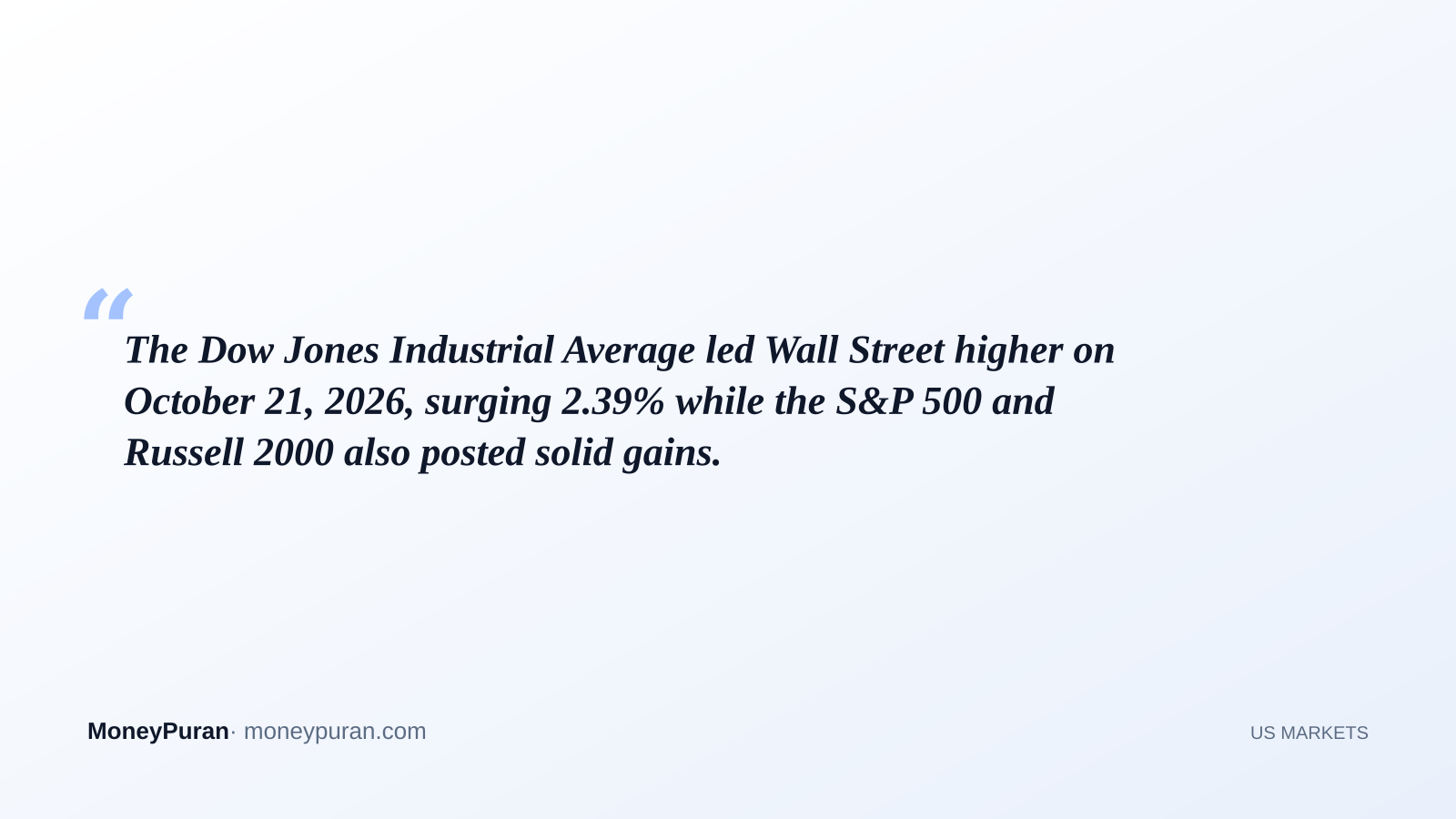
The Dow Jones Industrial Average led Wall Street higher on October 21, 2026, surging 2.39% while the S&P 500 and Russell 2000 also posted solid gains.
Key points
- Dow Jones Industrial Average closed up 2.39% at 52,856.09
- S&P 500 gained 0.50% to finish the session at 7,757.17
- Nasdaq Composite edged up 0.4% to reach 26,702.86
- US 10-Year Treasury Yield rose to 5.15%
- CBOE Volatility Index (VIX) ticked up to 16.68
Wall Street finished the trading session on October 21, 2026, with widespread gains across major indices, led by a powerful advance in blue-chip equities. The US stock market demonstrated broad strength as industrial and small-cap stocks outperformed technology shares during the session.
According to market data released at the close, the Dow Jones Industrial Average recorded the strongest performance among major benchmarks, jumping 2.39% or 1,234.61 points to settle at 52,856.09. The index traded within a wide daily range between 52,392.28 and 52,860.11.
S&P 500 and Russell 2000 advance
The broader S&P 500 index added 0.50% to close at 7,757.17, moving higher from its previous close of 7,718.94. Meanwhile, the technology-heavy Nasdaq Composite posted a muted gain of 0.04%, ending the day essentially flat at 26,702.86 after fluctuating between 26,507.07 and 26,778.90.
Small-cap companies also participated in the rally. The Russell 2000 index climbed 1.89% to finish the session at 2,781.02, reflecting robust investor participation across smaller domestic enterprises.
Yields and volatility tick higher
In fixed-income markets, the US 10-Year Treasury Yield rose 1.12% to settle at 5.15%, moving up from the previous close of 5.09%. Market sentiment gauges also shifted slightly, with the CBOE Volatility Index (VIX) increasing 1.34% to 16.68, indicating a mild pickup in options-market hedging activity despite the rising equity prices.
- Dow Jones Industrial Average: 52,856.09 (+2.39%)
- S&P 500: 7,757.17 (+0.50%)
- Nasdaq Composite: 26,702.86 (+0.04%)
- Russell 2000: 2,781.02 (+1.89%)
- US 10-Year Treasury Yield: 5.15% (+1.12%)
What this means for investors
For investors monitoring global capital flows, sharp moves in US benchmark indices often dictate sentiment in international equities, including Indian markets through foreign portfolio investor (FPI) allocations. When US indices like the Dow and S&P 500 experience strong buying pressure, it typically influences risk appetite across emerging markets.
At the same time, the climb in the US 10-Year Treasury yield to 5.15% remains a critical metric for global liquidity. Higher US yields can increase borrowing costs globally and impact currency dynamics, particularly regarding the relative strength of the US dollar against emerging market currencies like the Indian rupee.
Frequently asked questions
What were the closing levels for the major US indices? The Dow Jones closed at 52,856.09, the S&P 500 at 7,757.17, and the Nasdaq Composite at 26,702.86.
How did bond yields move during the session? The US 10-Year Treasury yield increased by 1.12% to reach 5.15%.
This article is for information only and is not investment advice. Do your own research or consult a licensed adviser before investing.

Based on information published by MoneyPuran market data. Source: MoneyPuran market data. Spotted an error? corrections@moneypuran.com