 Money
Money

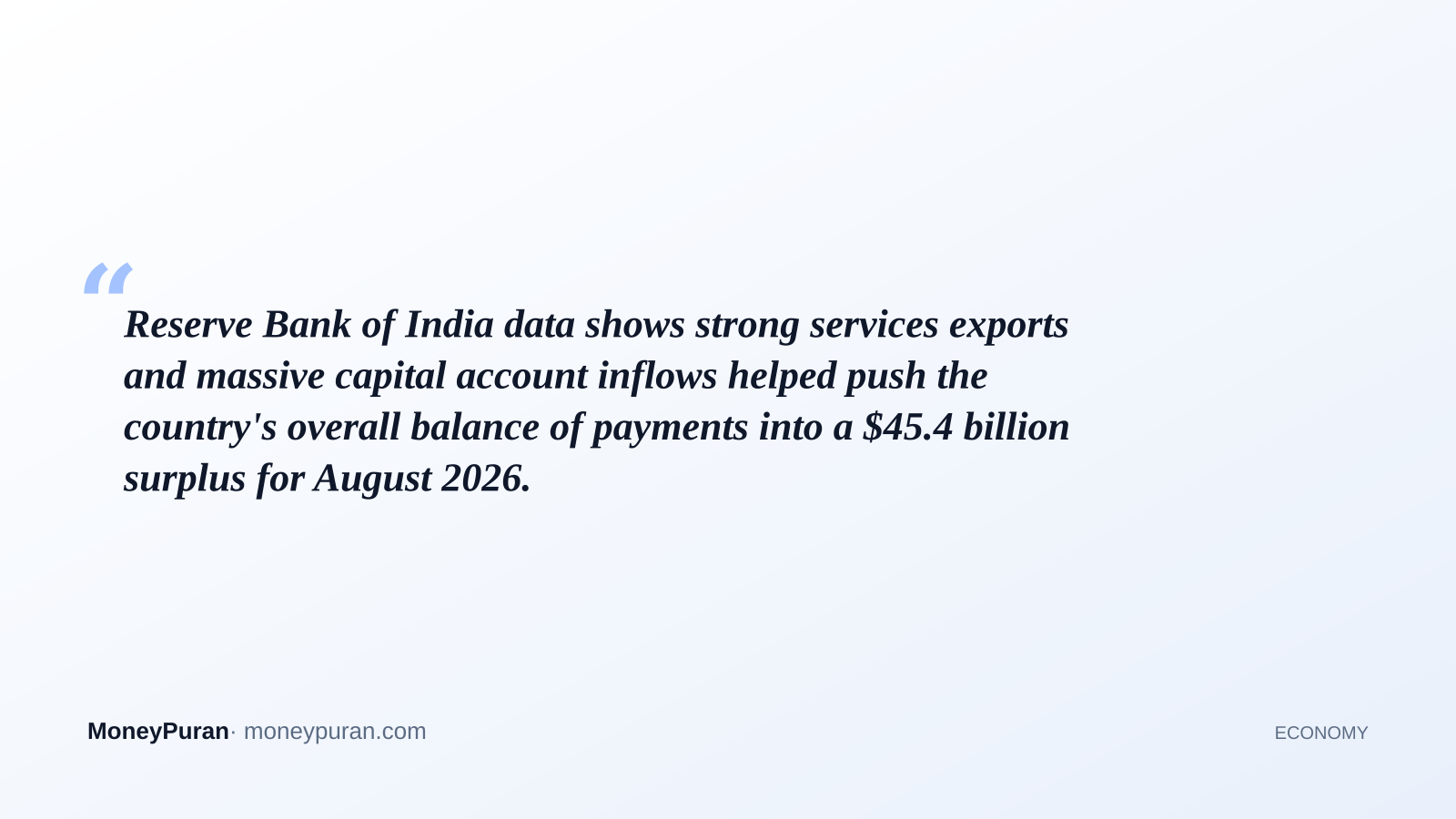
Reserve Bank of India data shows strong services exports and massive capital account inflows helped push the country’s overall balance of payments into a $45.4 billion surplus for August 2026.
Key points
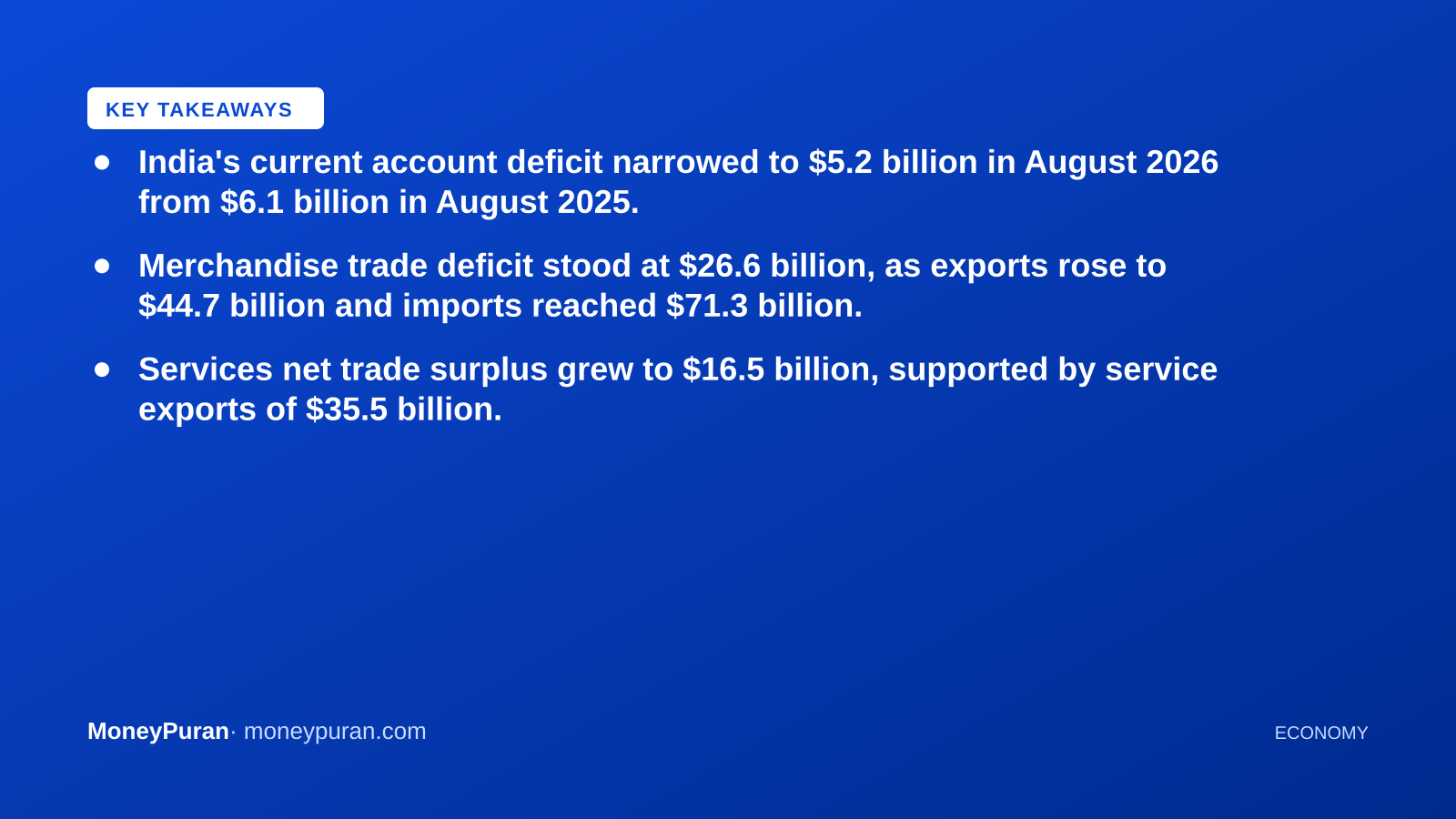
- India’s current account deficit narrowed to $5.2 billion in August 2026 from $6.1 billion in August 2025.
- Merchandise trade deficit stood at $26.6 billion, as exports rose to $44.7 billion and imports reached $71.3 billion.
- Services net trade surplus grew to $16.5 billion, supported by service exports of $35.5 billion.
- Capital account surplus surged to $50.6 billion, driven by robust banking capital and foreign investments.
- The overall balance of payments recorded a massive surplus of $45.4 billion in August 2026.
India current account deficit narrowed to $5.2 billion in August 2026, down from $6.1 billion recorded in August 2025, according to preliminary balance of payments data released by the Reserve Bank of India (RBI). The improvement in the current account balance was anchored by strong growth in services exports and stable private transfers, helping offset the country’s ongoing merchandise trade gap.
Alongside the narrowing current account deficit, India recorded a dramatic turnaround in its capital account, which saw net inflows jump to $50.6 billion in August 2026 from $0.5 billion in the same month a year earlier. Fueled by heavy capital receipts, India’s overall balance of payments swung to a substantial surplus of $45.4 billion for the month, compared to a deficit of $5.6 billion in August 2025.
Trade balance and services surplus details
The merchandise trade deficit for August 2026 came in at $26.6 billion, narrowing slightly from $27.6 billion in August 2025. Merchandise exports for the month jumped to $44.7 billion, up from $35.1 billion a year ago. Meanwhile, merchandise imports rose to $71.3 billion compared to $62.7 billion in the corresponding period last year.
India’s services trade continued to provide a robust buffer for the overall current account. Net services income increased to $16.5 billion in August 2026 from $15.6 billion in August 2025. Services exports reached $35.5 billion against imports of $18.9 billion during the month. Net secondary income, representing secondary transfers such as remittances, rose to $12.8 billion compared to $12.2 billion in the prior-year period.
Capital account surge and foreign investment flows
The standout feature of the August 2026 balance of payments report was the massive expansion in net capital inflows, which reached $50.6 billion. A significant portion of this inflow was concentrated in banking capital, which registered net receipts of $64.7 billion, led by non-resident Indian (NRI) deposits totaling $83.0 billion.
Foreign direct investment (FDI) and portfolio flows also contributed positively to the capital account balance during the month:
- Net FDI in India: Recorded at $5.2 billion in August 2026, up from $2.0 billion in August 2025.
- Net FPI in India: Inflows into Indian securities turned positive at $1.9 billion, compared to net outflows of $2.5 billion in August 2025.
- Cumulative CAD: For April-August 2026, the cumulative current account deficit widened to $18.3 billion from $12.8 billion in the prior fiscal period, primarily due to a larger five-month merchandise deficit of $146.0 billion.
- Cumulative Overall Balance: Reached a surplus of $58.0 billion for the April-August 2026 period.
What this means for investors
For investors tracking Indian equity and debt markets, a narrowing current account deficit paired with a massive overall balance of payments surplus provides a reassuring macroeconomic backdrop. The strong influx of foreign currency helps bolster the Reserve Bank of India’s foreign exchange reserves, giving the central bank greater firepower to manage volatility in the Indian rupee against major global currencies.
A resilient external account generally helps stabilize domestic bond yields by reducing sovereign risks and shielding the broader economy from external trade shocks. The strength in service exports and steady remittance inflows highlight structural competitive advantages in India’s services sector, which continues to cushion the wider trade deficit.
Equity market investors should monitor whether the surge in capital account flows, particularly in foreign portfolio investments and NRI deposits, remains consistent over the remainder of the fiscal year. Persistent capital inflows tend to support liquidity across Indian financial markets, providing positive sentiment for foreign institutional participation.
Frequently asked questions
What is India’s balance of payments overall surplus for August 2026?
India recorded an overall balance of payments surplus of $45.4 billion in August 2026, swinging from a deficit of $5.6 billion in August 2025.
How much was India’s current account deficit in August 2026?
The current account deficit stood at $5.2 billion in August 2026, narrowing from $6.1 billion recorded in August 2025.
What caused the jump in capital account inflows?
The capital account surge to $50.6 billion was primarily driven by significant banking capital movements, including NRI deposit inflows, along with positive contributions from direct and portfolio investments.
This article is for information only and is not investment advice. Do your own research or consult a licensed adviser before investing.
Based on information published by Reserve Bank of India (RBI). Source: Reserve Bank of India (RBI). Spotted an error? corrections@moneypuran.com