 Money
Money

A detailed look at the tax rules surrounding Sovereign Gold Bonds, covering maturity redemptions, secondary market sales, and interest income.

Key points
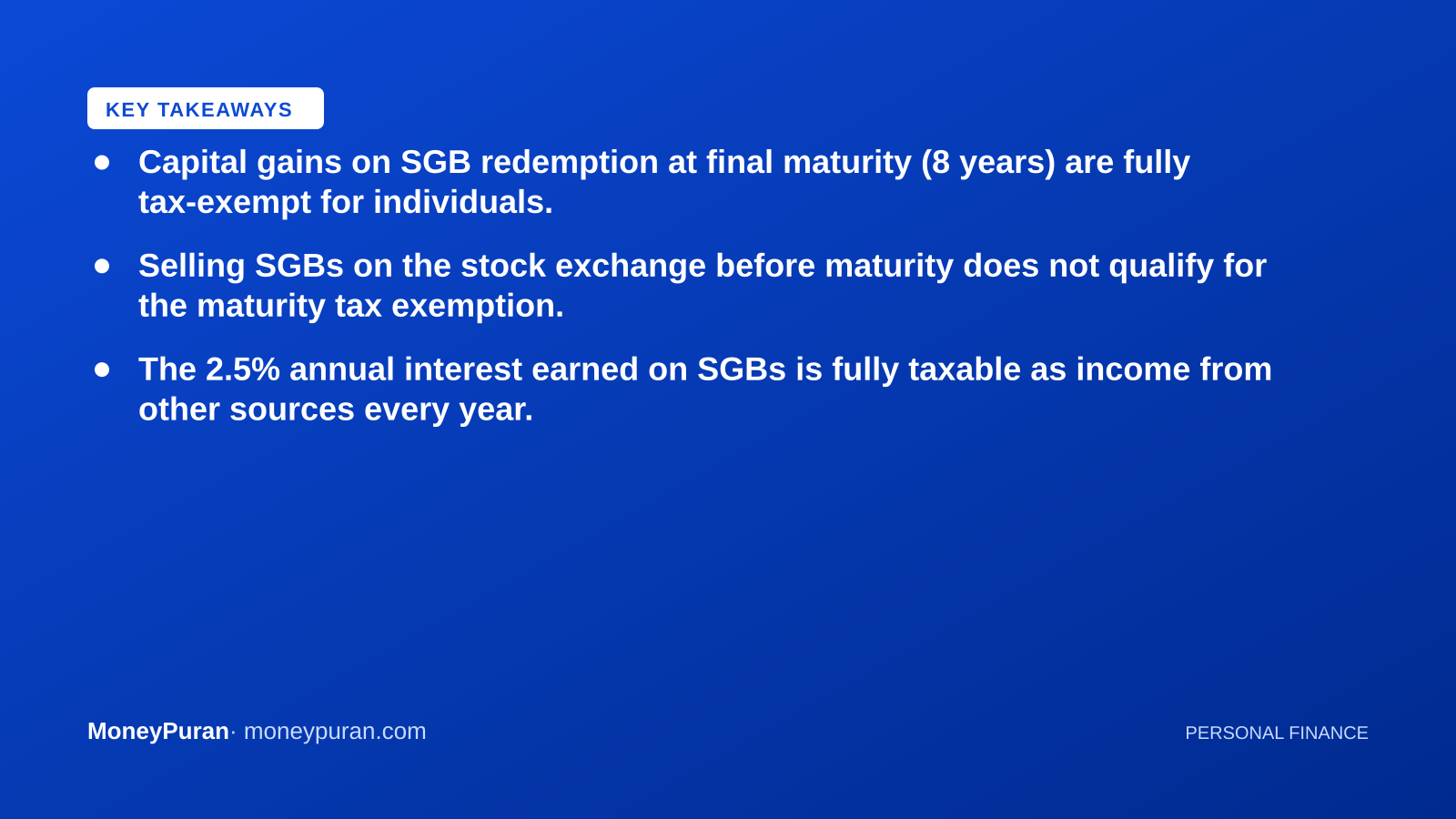
- Capital gains on SGB redemption at final maturity (8 years) are fully tax-exempt for individuals.
- Selling SGBs on the stock exchange before maturity does not qualify for the maturity tax exemption.
- The 2.5% annual interest earned on SGBs is fully taxable as income from other sources every year.
- Premature redemption through RBI after the fifth year also enjoys the capital gains tax exemption.
When investing in precious metals digitally, many buyers wonder if the sgb capital gains tax exemption is truly as beneficial as advertised. Sovereign Gold Bonds (SGBs) issued by the central bank on behalf of the government offer a unique tax perk that traditional physical gold and exchange-traded funds simply cannot match. However, this tax benefit is not a blanket rule that applies to every possible way you might exit your investment.
How the maturity tax exemption works
The core advantage of holding Sovereign Gold Bonds lies in Section 47 of the Income Tax Act. When an individual investor holds their bonds until the full eight-year maturity period and redeems them directly through the issuing authority, any capital gains arising from that redemption are completely exempt from tax. This means if the price of gold rises significantly over eight years, your entire profit on redemption remains untouched by the taxman.
This structure was designed to encourage long-term holdings of paper gold over physical bullion, reducing import dependency and securing domestic savings. You can also track the daily fluctuation of physical metal prices via resources like the gold rate today in India to understand how your underlying asset is performing over time.
The difference between maturity and secondary market sales
A common point of confusion for investors is how taxes apply if they exit their investment early. SGBs are tradable on stock exchanges, which provides liquidity if you need cash before the eight-year mark. However, if you sell your bonds on the secondary market instead of redeeming them with the issuer, the tax rules change entirely.
Selling SGBs on an exchange means you lose the special redemption tax exemption. Instead, standard capital gains rules apply:
- If you hold the bonds for more than the qualifying long-term period before selling on the exchange, your profits qualify as Long-Term Capital Gains (LTCG) with applicable indexation benefits.
- If you sell them before meeting the long-term holding threshold, the gains are treated as Short-Term Capital Gains (STCG) and added to your taxable income, taxed at your regular slab rate.
Step by step to secure your tax-free exit
To ensure you successfully claim the exemption when your investment period concludes, you must follow the correct operational channels:
- Hold your SGB units in a demat account or physical holding certificate directly linked to your primary bank details.
- Wait for the official eight-year maturity notification issued by the central bank or the designated depository participant.
- Submit your redemption request through your bank or broker specifically via the official redemption window rather than listing the units for sale on the stock exchange.
- Receive the maturity proceeds directly into your registered bank account, completely free of capital gains tax.
- Alternatively, utilize the authorized premature redemption window starting from the end of the fifth year on specified interest payment dates if you require early liquidity without visiting the stock market.
Periodic interest remains taxable
While the capital appreciation at the end of the journey enjoys tax-free status, the regular income generated by the asset does not. SGBs pay a fixed interest rate (typically around 2.5% per annum) credited semi-annually to the investor’s bank account. This interest is fully taxable every single year under the head ‘Income from Other Sources’ according to your applicable income tax slab, regardless of whether you hold the bond to maturity or sell it early.
Frequently asked questions
Does the tax exemption apply to Hindu Undivided Families (HUF) or corporate investors? No, the specific statutory exemption on redemption capital gains applies strictly to individual investors. Non-individual entities should consult tax professionals regarding corporate tax treatment.
What happens if I gift my SGBs to a family member? Transferring SGBs as a gift may attract clubbing provisions or specific tax implications depending on who receives the gift and whether consideration is involved, though the original exemption status can sometimes transfer under specific estate rules.
Are capital losses on SGBs eligible for set-off? If you sell SGBs on the secondary market at a loss, those capital losses can typically be set off against other capital gains according to standard tax loss harvesting rules.
This article is for general education and is not investment, tax or financial advice. Rules and figures change — check the official source or a licensed adviser before acting.
Official information: https://www.rbi.org.in
This explainer is published by the MoneyPuran desk for general awareness. Rules, limits and rates change over time — please confirm with the official source. Corrections: corrections@moneypuran.com