 Money
Money
The Reserve Bank of India issues the fifth amendment to capital adequacy directions for All India Financial Institutions, modifying risk weights for trade exposures to Qualified Central Counterparties.
Key points
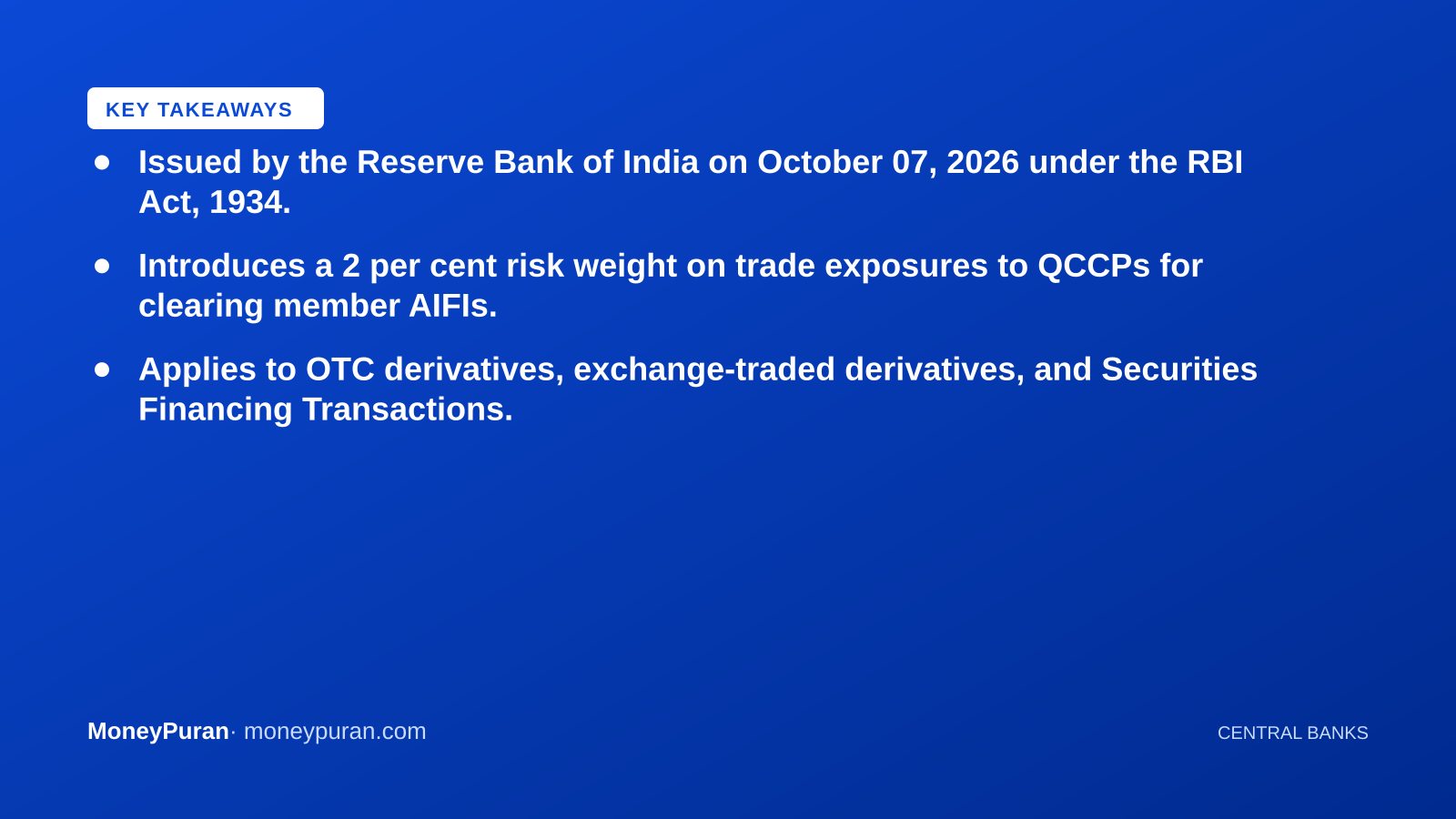
- Issued by the Reserve Bank of India on October 07, 2026 under the RBI Act, 1934.
- Introduces a 2 per cent risk weight on trade exposures to QCCPs for clearing member AIFIs.
- Applies to OTC derivatives, exchange-traded derivatives, and Securities Financing Transactions.
The Reserve Bank of India (RBI) has issued the All India Financial Institutions (AIFIs) Prudential Norms on Capital Adequacy Fifth Amendment Directions, 2026, altering the risk-weight framework for clearing member financial institutions. Announced by Chief General Manager Sunil T S Nair, the updated regulations align domestic guidelines with international standards regarding Qualified Central Counterparties (QCCPs).
Under the revised framework, where an AIFI acts as a clearing member of a QCCP for its own purposes, a risk weight of 2 per cent applies to the institution’s trade exposure. This valuation covers over-the-counter (OTC) derivatives transactions, exchange-traded derivatives transactions, and Securities Financing Transactions (SFTs). Furthermore, the same 2 per cent risk weight extends to cases where the AIFI offers clearing services to clients and remains obligated to reimburse those clients for losses if the QCCP defaults.
Aligning with Global Standards
The regulatory adjustments stem from a comprehensive review of existing clearing member requirements, specifically concerning legal opinions and trade exposures. By adopting a precise 2 per cent risk weight for QCCP exposures, the central bank aims to provide clarity for institutional balance sheets while maintaining robust prudential safeguards across India’s financial sector.
All India Financial Institutions operating as clearing members must immediately incorporate these revised parameters into their ongoing risk management and capital calculation protocols. The directions take effect from the date of issue, superseding previous sub-paragraph provisions outlined in the 2025 Master Directions.
What this means for investors
For investors monitoring Indian financial institutions, changes to capital adequacy norms directly influence how much capital institutions must set aside against specific operational exposures. A lower, well-defined risk weight such as 2 per cent for QCCP exposures optimizes capital allocation for clearing members.
While these technical adjustments apply directly to institutional balance sheets rather than retail equities, they underscore the central bank’s continuous effort to harmonize domestic banking regulations with international benchmarks. Investors should observe how institutional capital buffers adapt across the broader financial services sector as compliance measures take effect.
Frequently asked questions
Who do these new directions apply to? The amendments apply to All India Financial Institutions (AIFIs) acting as clearing members of Qualified Central Counterparties.
What is the new risk weight for QCCP exposures? A risk weight of 2 per cent is applied to trade exposures involving OTC derivatives, exchange-traded derivatives, and SFTs.
This article is for information only and is not investment advice. Do your own research or consult a licensed adviser before investing.
Based on information published by Reserve Bank of India (RBI) — notifications. Source: Reserve Bank of India (RBI) — notifications. Spotted an error? corrections@moneypuran.com