 Money
Money
Stephen Kenneth Leech II settles civil charges over a trade-allocation scheme that funneled gains to favored portfolios, bringing total recovery against the firm and executive to $103 million.
Key points
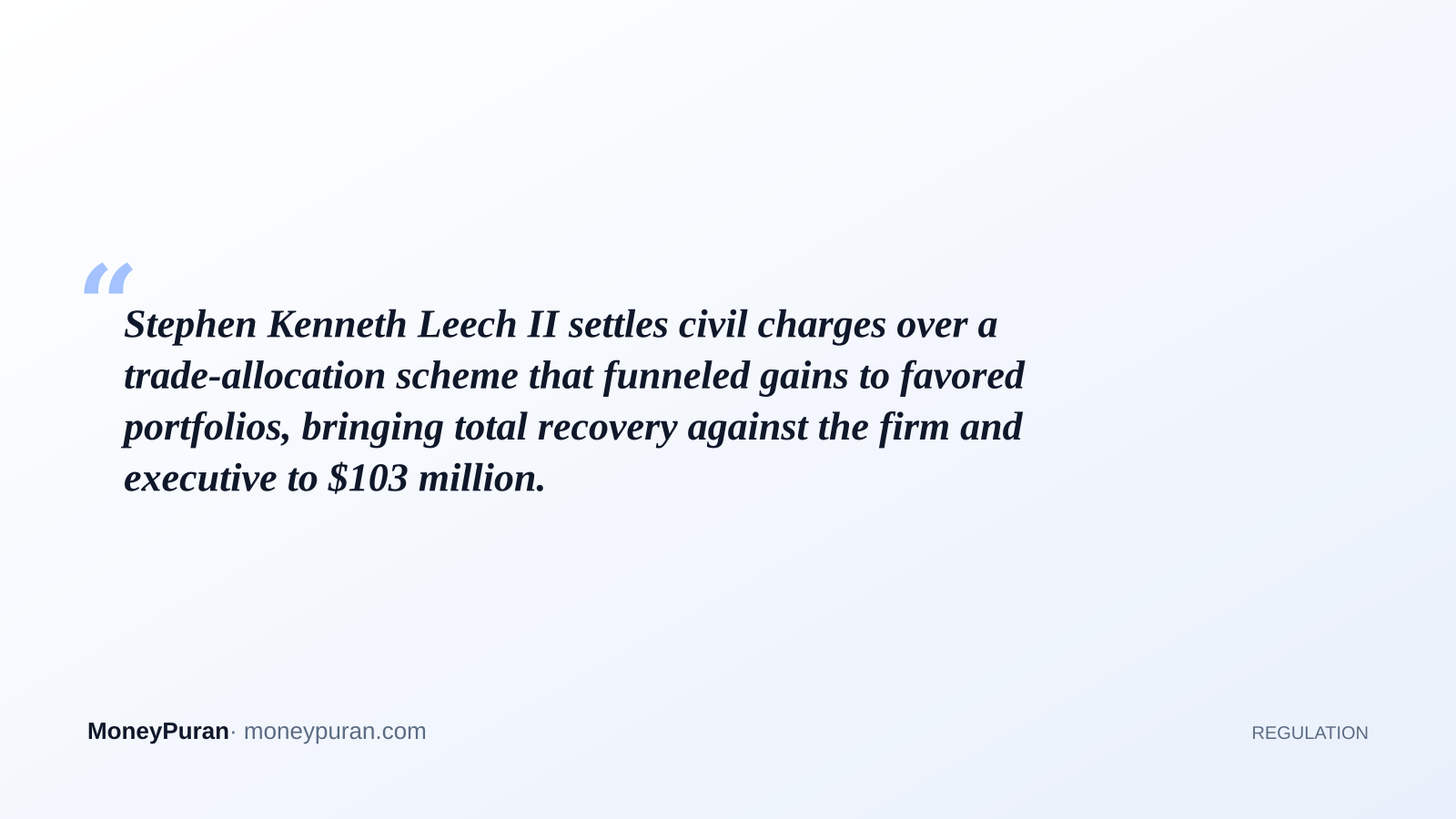
- Former Western Asset Co-CIO Stephen Kenneth Leech II consented to a $3 million civil penalty and a corporate officer bar to resolve SEC fraud charges.
- The SEC alleged Leech ran a multi-year cherry-picking scheme from January 2021 to October 2023, steering hundreds of millions in gains to favored portfolios.
- Western Asset previously agreed to pay $100 million in June 2026 to create an investor recovery Fair Fund.
- Leech pleaded guilty in June 2026 to criminal obstruction of justice charges stemming from false statements made during the SEC investigation.
The U.S. Securities and Exchange Commission (SEC) moved for a final consent judgment against Stephen Kenneth Leech II, the former co-chief investment officer of registered investment adviser Western Asset Management Company LLC. Leech agreed to pay a $3 million civil penalty and accept severe industry bans to resolve charges arising from a multi-year SEC cherry picking scheme that disproportionately misallocated trades across client accounts.
Under the proposed settlement, which remains subject to court approval, Leech agreed to the $3 million fine, an officer-and-director bar, a permanent injunction against violating federal securities antifraud laws, and a forthcoming associational bar. He consented to the judgment without admitting or denying the allegations set forth in the regulatory complaint.
How the Western Asset Trade Misallocation Scheme Worked
According to the SEC’s initial November 2024 complaint, Leech executed an improper allocation strategy between at least January 2021 and October 2023. As co-chief investment officer, he regularly placed trades but delayed assigning those transactions to specific client accounts until near or after daily settlement prices were established in futures markets.
By delaying the trade entries, Leech observed first-day price movements before finalizing allocations. This delay allowed him to direct hundreds of millions of dollars in first-day unrealized and realized gains into favored client portfolios, while pushing similar amounts in immediate trading losses onto disfavored client accounts. The SEC highlighted the conduct as an egregious breach of fundamental fiduciary duties owed by an asset manager to every client account under management.
$103 Million Total Relief and Criminal Obstruction Guilty Plea
The proposed resolution with Leech builds on a prior regulatory settlement involving the asset manager itself. In June 2026, the SEC instituted settled administrative proceedings against Western Asset Management Company, ordering the firm to pay a $100 million civil penalty. The regulator established a Fair Fund with those proceeds to distribute monetary restitution directly to the disfavored portfolios that suffered misallocated losses.
Combined, the firm’s $100 million penalty and Leech’s $3 million fine will return $103 million to impacted investors. Alongside civil proceedings, Leech faced federal criminal prosecution in the U.S. District Court for the Southern District of New York. In June 2026, he pleaded guilty to obstruction of justice charges after providing false and misleading testimony to SEC investigators during the regulatory inquiry. His criminal sentencing is scheduled for the coming weeks.
What this means for investors
Trade misallocation and cherry-picking strike at the heart of portfolio management integrity. When asset managers pool order execution, regulations mandate prompt and equitable trade allocation to ensure fair treatment across all client portfolios. For institutional investors, pension funds, and individual account holders, the resolution demonstrates how delayed allocation practices can systematically disadvantage certain funds in favor of others.
For global asset allocators, including Indian institutional investors and high-net-worth funds holding exposure to U.S. fixed-income products, the creation of an SEC Fair Fund offers a mechanism for returning recovered capital to damaged accounts without requiring private litigation. The enforcement action serves as a reminder that investment mandates require rigorous trade-reporting controls to verify that portfolio execution matches pre-trade allocation instructions.
Investors evaluating asset managers should review compliance disclosures and regulatory filings for red flags concerning trade-aggregation procedures. Tracking SEC Fair Fund distributions allows impacted fund holders to follow the progress of restitution payments across affected accounts.
Frequently asked questions
What is cherry picking in asset management? Cherry picking refers to an illegal trade-allocation scheme where an investment manager executes trades and waits to assign them to specific client accounts until the direction of the market is known, steering winning trades to favored portfolios and losing trades to disfavored ones.
How much will affected investors receive from the SEC enforcement action? The SEC’s combined resolutions with Western Asset ($100 million) and former Co-CIO Ken Leech ($3 million) will establish a combined total of $103 million to compensate investors who suffered losses in disfavored portfolios.
What criminal charges did Ken Leech face? In addition to SEC civil regulatory penalties, Leech pleaded guilty in federal court to criminal obstruction of justice for making false and misleading statements to SEC officials during the investigation.
This article is for information only and is not investment advice. Do your own research or consult a licensed adviser before investing.
Based on information published by U.S. Securities and Exchange Commission (SEC). Source: U.S. Securities and Exchange Commission (SEC). Spotted an error? corrections@moneypuran.com