 Money
Money

Latest RBI weekly statistical data shows scheduled commercial bank credit expanding alongside robust foreign exchange reserves holding above $747 billion.
Key points
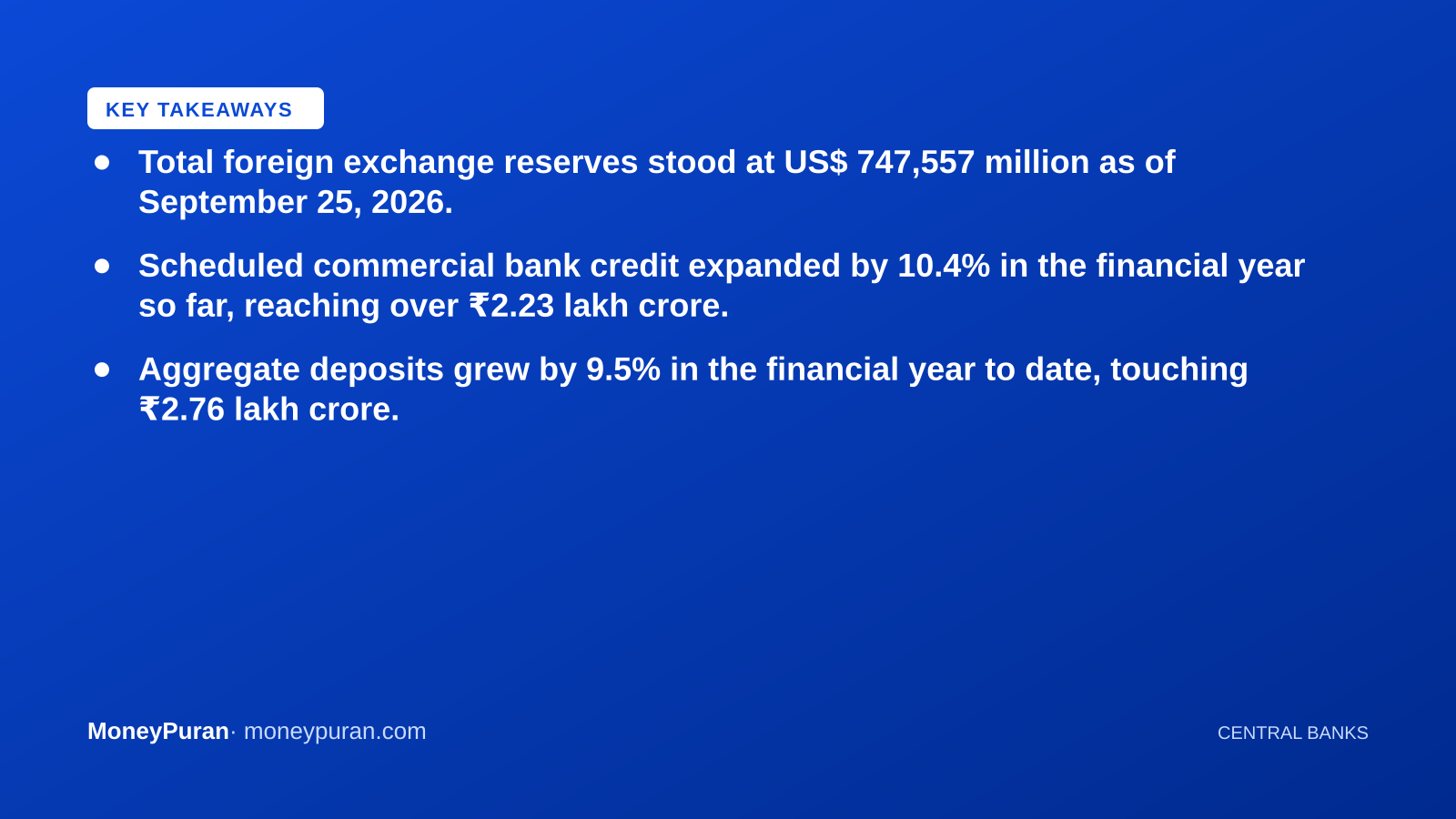
- Total foreign exchange reserves stood at US$ 747,557 million as of September 25, 2026.
- Scheduled commercial bank credit expanded by 10.4% in the financial year so far, reaching over ₹2.23 lakh crore.
- Aggregate deposits grew by 9.5% in the financial year to date, touching ₹2.76 lakh crore.
Bank credit growth across Indian scheduled commercial banks maintained a steady pace, according to the latest weekly statistical supplement released by the Reserve Bank of India (RBI). The data, covering the period up to mid-September 2026, highlights ongoing liquidity dynamics within the domestic banking sector alongside robust figures for the country’s foreign exchange reserves.
Scheduled commercial bank business figures showed aggregate deposits expanding by 9.5% in the financial year so far, reaching an outstanding level of ₹2,76,23,066 crore as of September 15, 2026. Meanwhile, total bank credit stood at ₹2,23,29,258 crore, reflecting a growth rate of 10.4% over the financial year. Non-food credit formed the lion’s share of this lending activity, amounting to ₹2,22,19,537 crore.
Foreign Reserves Scale Higher
The RBI report indicated that India’s total foreign exchange reserves reached US$ 747,557 million (₹71,64,287 crore) as of September 25, 2026. Foreign currency assets, the largest component of the reserves, were recorded at US$ 615,411 million. Gold reserves accounted for US$ 108,701 million, while Special Drawing Rights (SDRs) and the reserve position in the IMF stood at US$ 18,642 million and US$ 4,804 million, respectively.
On the liquidity front, RBI operations showed net absorption through various liquidity adjustment facilities during the week of late September 2026, with variable rate reverse repos and the standing deposit facility absorbing excess liquidity from the banking system. Net absorption figures fluctuated between ₹1.82 lakh crore and ₹3.11 lakh crore across the reported dates.
What this means for investors
For Indian investors, steady bank credit growth is generally viewed as a positive indicator of underlying economic demand and corporate borrowing activity. When commercial banks continue to disburse credit at double-digit financial year growth rates, it signals that sectors from manufacturing to retail are utilizing capital for expansion and working capital needs.
At the same time, healthy foreign exchange reserves provide a vital cushion for the Indian rupee against global macroeconomic volatility, foreign capital outflows, and swings in international commodity prices like crude oil. Investors often monitor these weekly RBI bulletins to gauge systemic liquidity, credit-deposit ratios, and how smoothly monetary policy transmission is operating within the domestic financial markets.
Frequently asked questions
What does non-food credit measure? Non-food credit represents the total loans and advances given by scheduled commercial banks to various sectors excluding food procurement operations, serving as a primary gauge of private sector borrowing.
Why are foreign exchange reserves important for the markets? Large forex reserves act as a buffer for the central bank to manage excessive volatility in the exchange rate of the Indian rupee and maintain stability in external trade.
This article is for information only and is not investment advice. Do your own research or consult a licensed adviser before investing.
Based on information published by Reserve Bank of India (RBI). Source: Reserve Bank of India (RBI). Spotted an error? corrections@moneypuran.com