 Money
Money
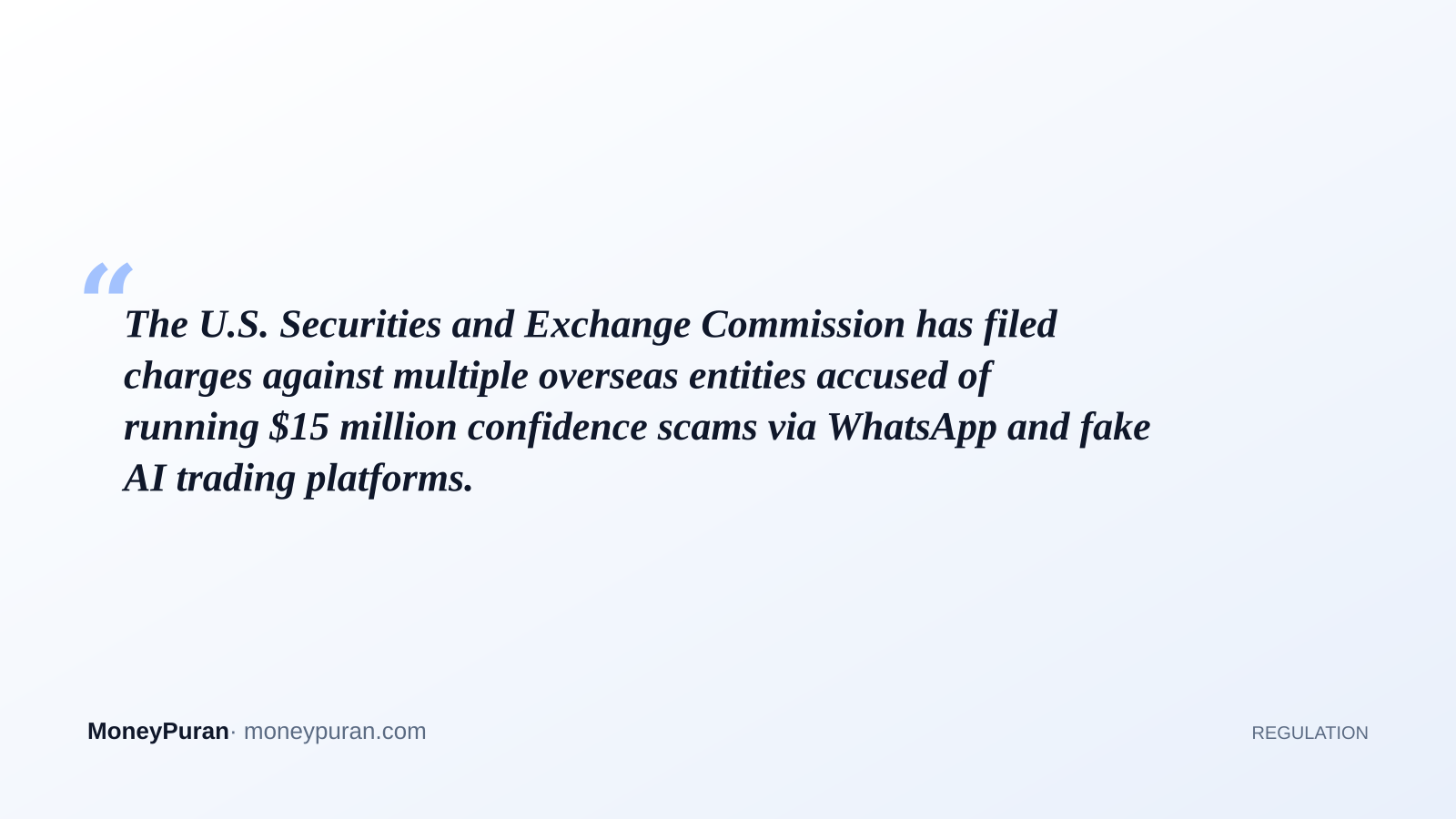
The U.S. Securities and Exchange Commission has filed charges against multiple overseas entities accused of running $15 million confidence scams via WhatsApp and fake AI trading platforms.
Key points
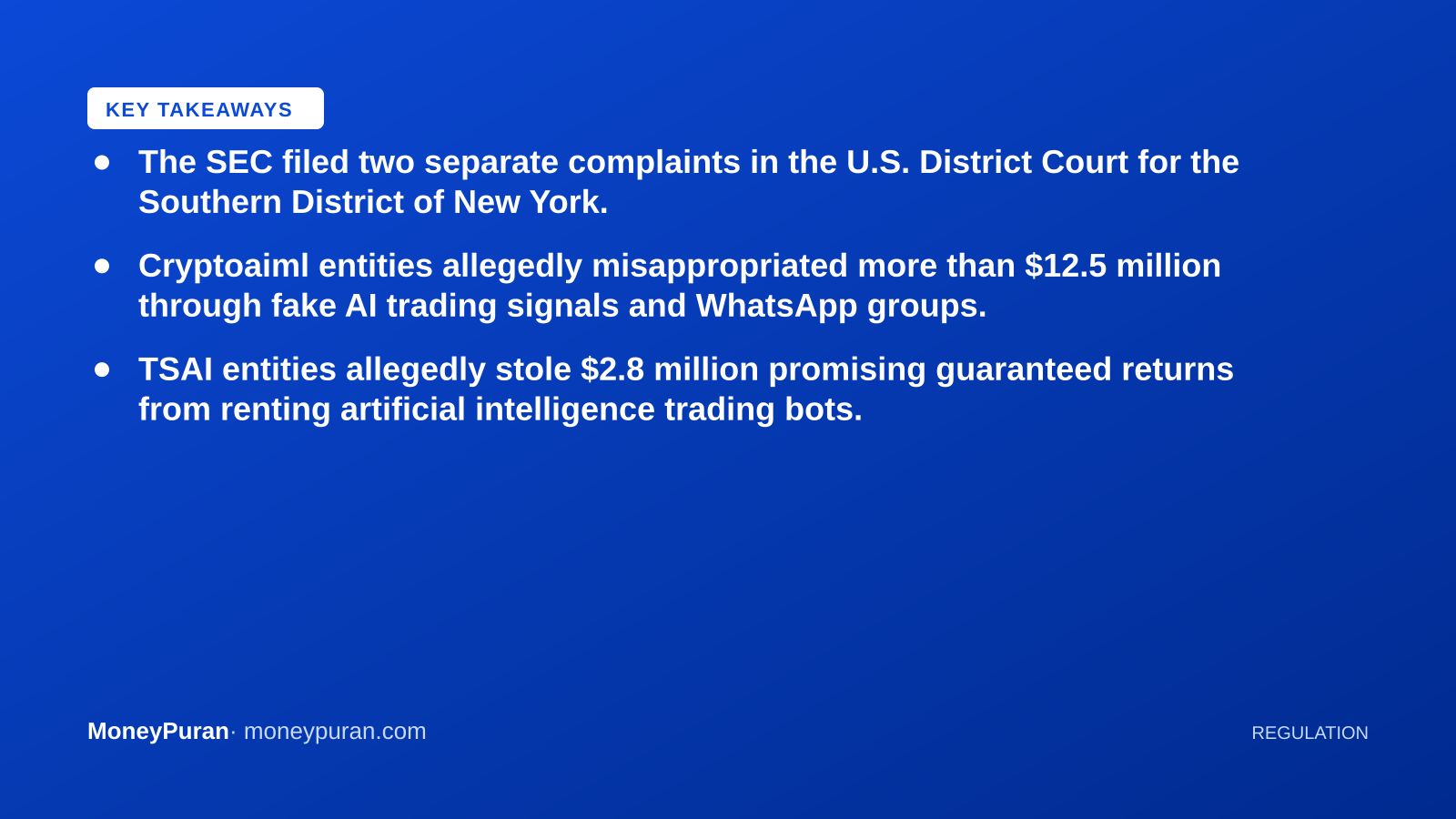
- The SEC filed two separate complaints in the U.S. District Court for the Southern District of New York.
- Cryptoaiml entities allegedly misappropriated more than $12.5 million through fake AI trading signals and WhatsApp groups.
- TSAI entities allegedly stole $2.8 million promising guaranteed returns from renting artificial intelligence trading bots.
- Both schemes falsely claimed to be regulated by the SEC and displayed falsified Form D documents.
The U.S. Securities and Exchange Commission (SEC) announced fraud charges against multiple entities accused of orchestrating online investment confidence schemes that targeted hundreds of retail investors and stole at least $15 million. According to the regulatory agency, the perpetrators predominantly used messaging platforms like WhatsApp, social media, and fake websites to lure unsuspecting victims by promising outsized returns through artificial intelligence trading signals and automated bots.
In two separate complaints filed in the U.S. District Court for the Southern District of New York, the SEC targeted Cryptoaiml Ltd. along with Cryptoaiml Capital Foundation, and TSAI Pro Ltd. alongside TSAI Capital Foundation. Investigators state that the schemes operated from mid-2024 through early 2025, misappropriating more than $12.5 million and $2.8 million respectively. David Woodcock, Director of the SEC’s Division of Enforcement, noted that the fraudsters attempted to build trust by impersonating professionals, fabricating investment adviser relationships, and displaying falsified regulatory filings on their websites.
How the WhatsApp and AI Trading Scams Operated
The regulatory filings detail distinct methods used by the charged entities to defraud clients, though both shared core deceptive practices. The Cryptoaiml operation allegedly formed WhatsApp group chats where individuals posed as financial experts providing profitable crypto trading tips. Victims were directed to open accounts on a fake trading platform where balance sheets and profit figures were entirely fictitious. When investors attempted to withdraw their funds, they were met with demands for fraudulent advance fees under the guise of unfreezing their accounts.
Similarly, the TSAI entities utilized WhatsApp and public Facebook channels to promote guaranteed profits by renting out AI-driven trading bots. Investors were also encouraged to recruit new participants into the program. In both cases, the defendants sought to legitimize their operations by posting phony certificates and referencing falsified Form D documents, which have since been removed from the Commission website by regulators.
- Cryptoaiml scheme timeframe: August 2024 through March 2025.
- TSAI scheme timeframe: September 2024 to March 2025.
- Total alleged misappropriated funds: At least $15 million across both cases.
- Falsified documentation: Phony Form D filings used to mimic SEC compliance.
What this means for investors
For retail participants and everyday investors, these enforcement actions highlight the persistent risks associated with unsolicited investment opportunities encountered on social media and messaging applications. Fraudsters frequently leverage buzzwords like artificial intelligence, algorithmic trading, and cryptocurrency to create an illusion of cutting-edge wealth generation. Furthermore, the misuse of regulatory terminology underscores the importance of independently verifying credentials rather than trusting screenshots or certificates displayed on private corporate websites.
Investors can protect their capital by utilizing official government resources such as Investor.gov to check the background and registration status of any individual or firm offering financial services. Regulators continuously warn that legitimate registered investment professionals will not promise guaranteed returns, demand crypto asset transfers to unverified platforms as the sole funding method, or condition withdrawals on upfront fee payments. Maintaining skepticism toward online groups promising high-yield returns remains a vital defense against sophisticated cross-border financial fraud.
Frequently asked questions
How did the fraudsters convince investors they were legitimate? The entities posted falsified Form D filings and fake certificates on their websites, falsely claiming they were officially certified and regulated by the SEC.
Where did the fraudulent activities primarily take place? The perpetrators used online platforms, including WhatsApp group chats, Facebook, and dedicated websites, to connect with retail investors located in the U.S. and overseas.
What should investors do if they encounter similar investment pitches? The SEC advises the public to verify registration details on Investor.gov and report suspicious schemes directly through the agency’s online tip portal.
This article is for information only and is not investment advice. Do your own research or consult a licensed adviser before investing.
Based on information published by U.S. Securities and Exchange Commission (SEC). Source: U.S. Securities and Exchange Commission (SEC). Spotted an error? corrections@moneypuran.com