 Money
Money
A clear guide on how to read, interpret, and analyze exchange rate trends using a rupee vs dollar graph for better financial awareness.
Key points
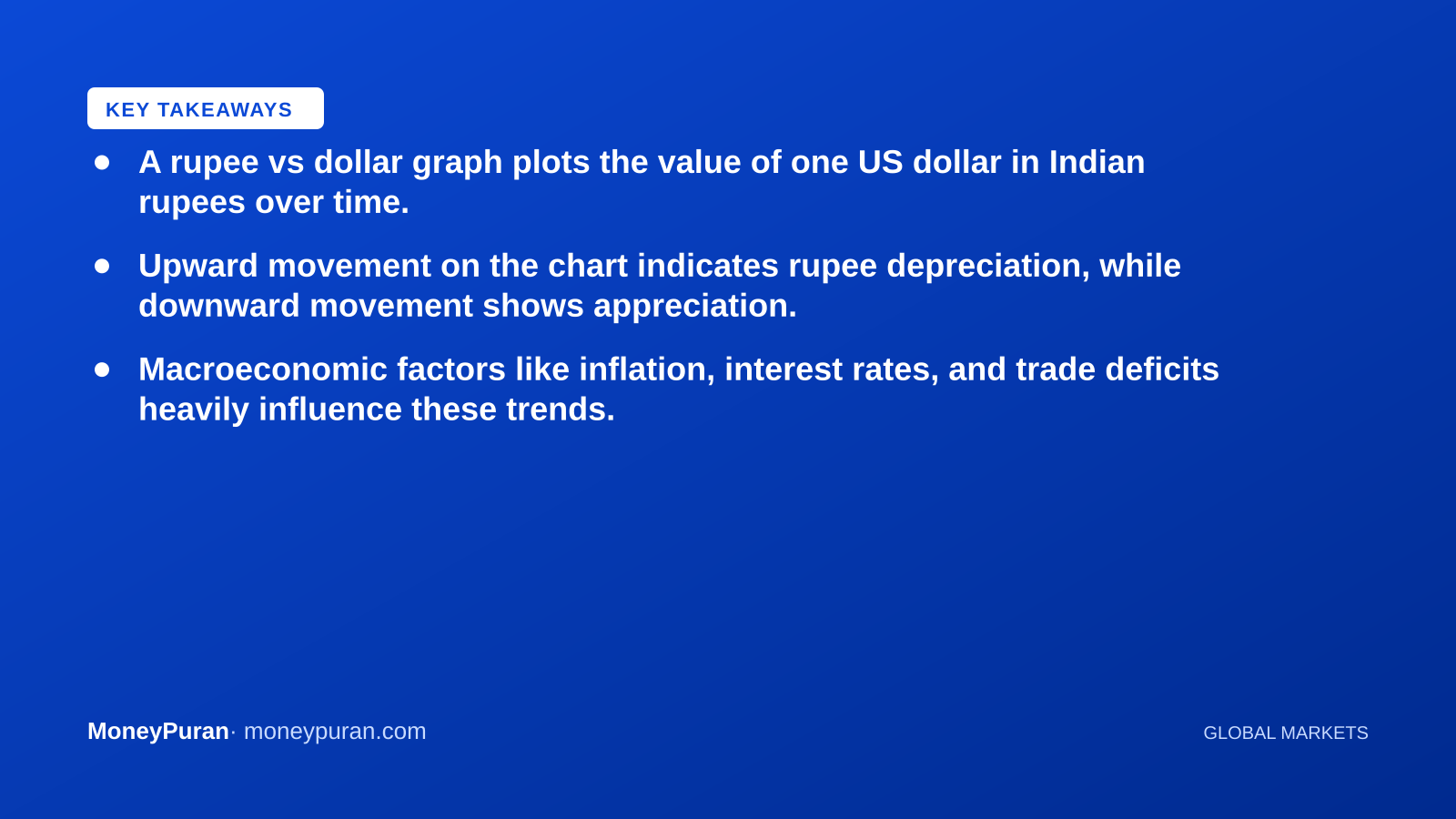
- A rupee vs dollar graph plots the value of one US dollar in Indian rupees over time.
- Upward movement on the chart indicates rupee depreciation, while downward movement shows appreciation.
- Macroeconomic factors like inflation, interest rates, and trade deficits heavily influence these trends.
- Tracking currency pairs helps both international remitters and global investors manage currency risk.
A rupee vs dollar graph is a visual representation of how the exchange rate between the Indian rupee (INR) and the US dollar (USD) changes over time. Whether you are tracking the USD to INR rate for remittances, travel, or global investments, understanding how to read these charts helps you make sense of currency market shifts. The graph typically plots dates or time intervals on the horizontal axis and the cost of one US dollar in rupees on the vertical axis.
What a currency chart actually shows
When you look at standard financial platforms, the currency pair is displayed as USD/INR. If the graph line moves upward, it means the dollar is getting stronger relative to the rupee, or equivalently, the rupee is weakening. For instance, if the figure moves from 82 to 83, it takes more rupees to buy a single dollar. Conversely, a downward-sloping line indicates that the rupee is strengthening against the dollar.
Key drivers behind exchange rate movements
Currency valuations are determined by global supply and demand dynamics. Several fundamental macroeconomic factors shape the trajectory seen on a currency chart:
- Interest Rates: Higher interest rates set by the US Federal Reserve or the Reserve Bank of India attract foreign capital, influencing currency demand.
- Inflation Differentials: Countries with lower inflation generally see their currencies appreciate over the long term compared to high-inflation economies.
- Trade Balances: A widening trade deficit means a country imports more than it exports, increasing the demand for foreign currency like the US dollar.
- Geopolitical Events: Global uncertainty often triggers a “flight to safety,” boosting demand for the US dollar as a global reserve currency.
How to analyze trends step by step
Interpreting a currency chart effectively requires looking beyond daily noise. Follow these steps to evaluate long-term trends:
- Select an appropriate timeframe, such as a 1-year, 5-year, or maximum historical view, to identify structural trends rather than short-term volatility.
- Identify key support and resistance levels where the exchange rate historically paused or reversed direction.
- Compare moving averages to spot whether the currency pair is in a short-term or long-term bullish or bearish phase.
- Cross-reference chart movements with major central bank policy announcements and macroeconomic data releases.
Perspective for US and Indian participants
For individuals earning in dollars in the United States and sending money back to India, a rising USD/INR exchange rate means higher purchasing power for every dollar converted. On the other hand, Indian residents importing goods, paying for foreign education, or planning international travel face higher costs when the dollar appreciates. Both US and Indian investors with cross-border exposure must monitor these fluctuations to assess the true return on their international assets once converted back to their home currency.
Frequently asked questions
Why does the exchange rate fluctuate constantly? Currencies trade continuously in global markets based on real-time economic data, geopolitical news, and shifting supply and demand from institutional and retail participants.
Does an upward trend mean the Indian economy is failing? Not necessarily. Exchange rates reflect relative strength between two specific economies. A rising USD/INR graph often reflects robust US economic growth or aggressive Federal Reserve policies alongside domestic factors.
Where can I find reliable, real-time currency charts? Trusted financial news portals, central bank websites like the Reserve Bank of India (rbi.org.in), and major global financial platforms offer accurate historical and live currency data.
This article is for general education and is not investment, tax or financial advice. Rules and figures change — check the official source or a licensed adviser before acting.
Official information: https://www.rbi.org.in
This explainer is published by the MoneyPuran desk for general awareness. Rules, limits and rates change over time — please confirm with the official source. Corrections: corrections@moneypuran.com