 Money
Money
Master the mechanics of automated exit orders, learn why they fail during extreme volatility, and explore better ways to protect your capital.
Key points
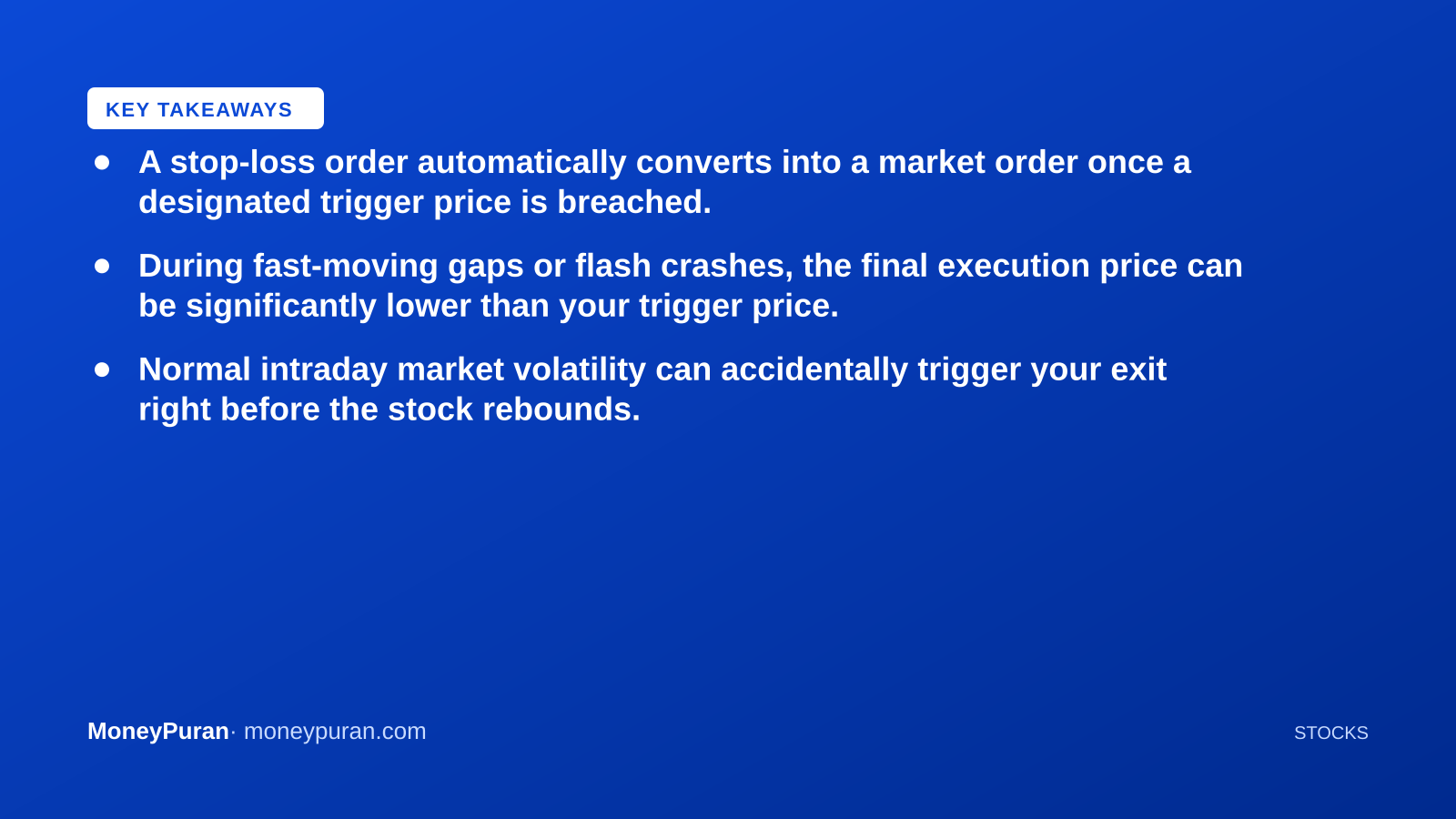
- A stop-loss order automatically converts into a market order once a designated trigger price is breached.
- During fast-moving gaps or flash crashes, the final execution price can be significantly lower than your trigger price.
- Normal intraday market volatility can accidentally trigger your exit right before the stock rebounds.
- Stop-limit variants guarantee a minimum price floor but carry the risk of leaving your trade completely unfilled.
When trading stocks in either the United States or international markets, protecting your hard-earned capital is just as important as finding profitable investments. A stop loss order is an automated instruction given to your brokerage account to sell a stock automatically if its price falls to a specified level. Designed primarily to limit downside risk and lock in accumulated gains, it acts as an emotional safety net so you do not have to watch stock market charts every second of the day.
The mechanics behind automated exit triggers
Understanding how this tool functions requires looking at its two distinct phases: the trigger and the execution. You select a specific price threshold that sits below your purchase price. As long as the stock trades above that threshold, your order remains inactive and waits quietly in the background.
The moment the stock touches or drops below your chosen price level, your order transforms instantly into a standard market order. Your broker attempts to execute the sale at the very next available market price. This seamless transition happens automatically within fractions of a second on modern electronic exchanges.
The hidden limits and risks of automated exits
While automated exits provide basic protection, they are far from foolproof. Experienced traders recognize several structural weaknesses that can catch unprepared investors off guard during turbulent market sessions:
- Gap-down openings: If bad news emerges overnight or over a weekend, a stock can open significantly lower than yesterday’s close. Your trigger might be set at 50, but if the stock gaps down to 40 at the opening bell, your order executes near 40 rather than 50.
- Whipsaw volatility: Normal market noise and temporary price dips can touch your trigger level, selling your shares instantly, only for the stock to reverse direction and surge upward immediately afterward.
- Zero after-hours protection: Standard orders generally only execute during regular trading hours. If a catastrophic event happens after the closing bell, your instruction will sit dormant until trading resumes.
- Stop-limit trade-offs: To prevent unexpected execution prices, some traders use a stop-limit variant which specifies a price floor. However, if the market plummets straight through that floor, your order may never fill at all, leaving you stranded with unwanted shares.
Smarter alternatives for managing risk
Relying solely on automated exits can create a false sense of security. Professional risk managers often emphasize broader strategies to safeguard a portfolio against unexpected downturns.
Proper position sizing is frequently a more effective risk control than any software instruction. By limiting the percentage of your total portfolio allocated to any single equity, you ensure that even a catastrophic loss in one company will not sink your overall financial standing. Combining disciplined asset allocation with diversified index funds often reduces the need to micromanage individual equity swings.
Regulatory differences between US and Indian markets
While the basic concept of an automated exit order remains identical across global exchanges like the NYSE, Nasdaq, NSE, and BSE, the specific terminology and broker platforms can vary. In the United States, brokerages operate under strict SEC and FINRA oversight, while Indian brokers follow guidelines established by SEBI. Furthermore, Indian markets feature specialized intraday product types with mandatory auto-square-off times, meaning automated instructions often interact with strict leverage rules that differ significantly from standard US cash or margin accounts.
Frequently asked questions
Does a stop loss order guarantee my exact selling price? No. Once triggered, it becomes a market order, meaning your shares sell at the next available price, which can be worse than your trigger price during fast markets.
Can I use these orders for options or crypto? Yes, most modern multi-asset brokerages extend these conditional instructions to options, exchange-traded funds, and digital assets, though rules vary by platform.
What is the difference between a stop and a stop-limit? A standard stop triggers a market order for guaranteed execution at any price, whereas a stop-limit triggers a limit order that guarantees a price but risks non-execution.
This article is for general education and is not investment, tax or financial advice. Rules and figures change — check the official source or a licensed adviser before acting.
Official information: https://www.investor.gov
This explainer is published by the MoneyPuran desk for general awareness. Rules, limits and rates change over time — please confirm with the official source. Corrections: corrections@moneypuran.com