 Money
Money
Discover the key differences between market orders and limit orders, how bid-ask spreads affect execution, and when to use each for maximum price control.
Key points
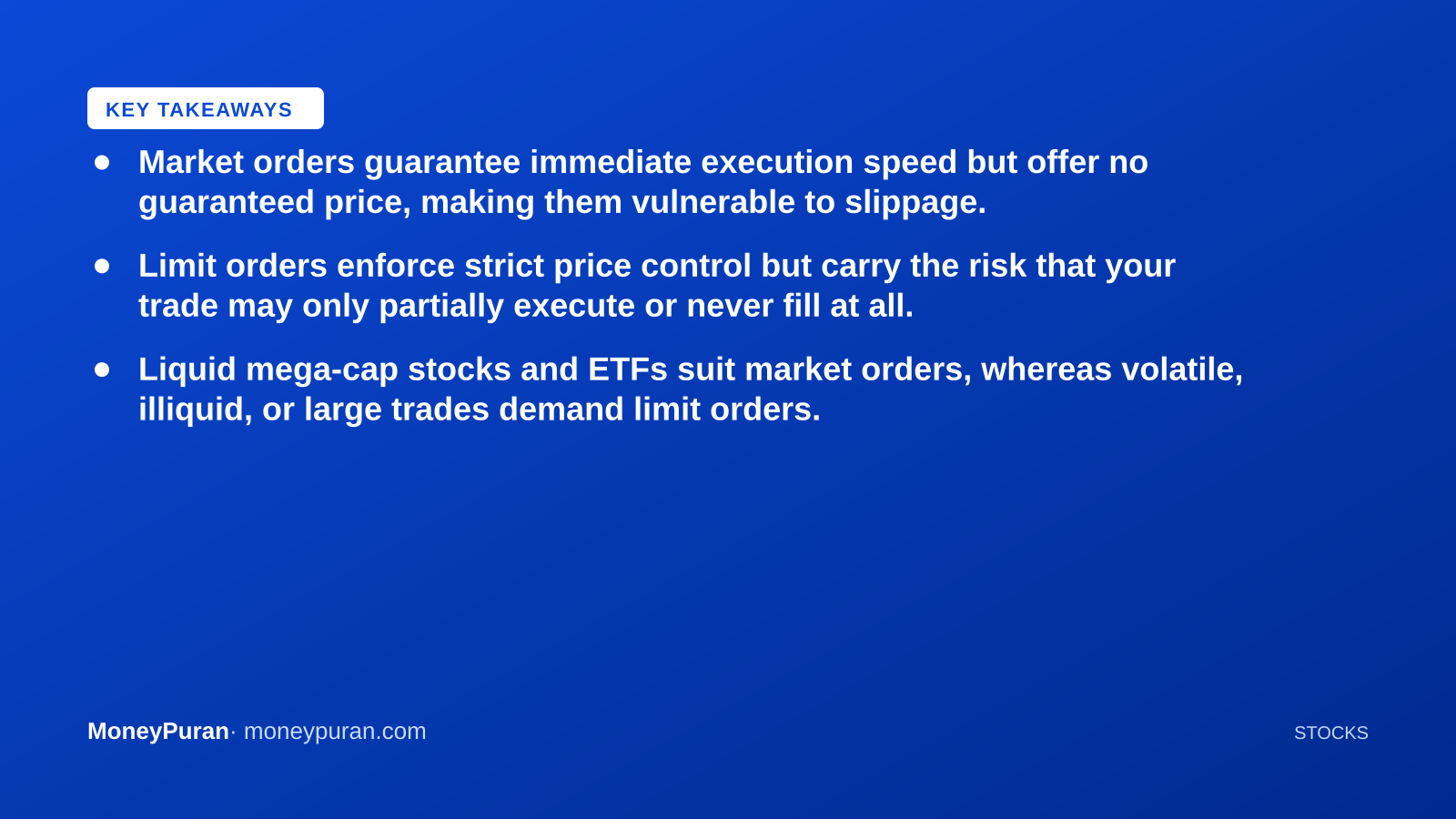
- Market orders guarantee immediate execution speed but offer no guaranteed price, making them vulnerable to slippage.
- Limit orders enforce strict price control but carry the risk that your trade may only partially execute or never fill at all.
- Liquid mega-cap stocks and ETFs suit market orders, whereas volatile, illiquid, or large trades demand limit orders.
- Bid-ask spreads determine how much extra you pay when using market orders in fast-moving or low-volume assets.
Choosing between a market order and a limit order comes down to a fundamental trade-off: speed versus price control. A market order guarantees your trade will execute immediately at the best available current price, but you cannot lock in the exact rate you pay or receive. Conversely, a limit order guarantees the exact price or better, but comes with no guarantee that your trade will actually be filled. Understanding how these two foundational order types work—and when to deploy each—protects your portfolio from unwanted price surprises.
What is a market order and how does it work?
A market order is an instruction to buy or sell a security immediately at whatever price the market currently offers. When you press the buy button using a market order, your broker sends the instruction straight to an exchange, where it matches instantly against existing sell quotes in the order book.
The principal advantage of a market order is certainty of execution. If the market is open and shares are available, your order will complete within milliseconds. This makes market orders ideal when getting into or out of a position rapidly matters far more than saving a few cents per share.
However, market orders carry the risk of price slippage. Slippage occurs when the execution price differs from the price displayed on your screen at the moment you placed the order. Because stock quotes refresh rapidly, fast-moving prices or thin market volume can cause your trade to execute at a less favorable price than anticipated.
What is a limit order and how does it work?
A limit order sets a strict boundary on the price you are willing to accept. When buying, a limit order establishes the maximum price you will pay per share. When selling, a limit order sets the minimum price you will accept.
Unlike market orders, limit orders prioritize price control over execution speed. If you place a buy limit order for a stock at $50 when it is currently trading at $52, your order sits inactive in the order book until a seller agrees to sell at $50 or lower. If the stock never drops to $50, your trade remains unexecuted.
Limit orders can be configured with time horizons, such as a Day order (which expires at the close of the trading session) or a Good ‘Til Canceled (GTC) order, which remains active across multiple trading days until filled or manually canceled.
The role of bid-ask spreads and liquidity
To choose between these order types intelligently, you must understand the bid-ask spread and stock liquidity. The bid price is the highest amount buyers are offering, while the ask price is the lowest amount sellers are demanding.
In highly liquid assets—such as large-cap companies or broad index exchange-traded funds (ETFs)—thousands of shares trade every second, and the gap between bid and ask is often just one cent. In these liquid names, market orders carry minimal slippage risk because deep liquidity absorbs ordinary trade sizes easily.
In contrast, low-volume small-cap stocks, illiquid bonds, or options contracts frequently suffer from wide bid-ask spreads. Placing a market order in an illiquid market can trigger severe slippage, as your order sweeps through multiple price levels in the order book to get filled. Using a limit order in these scenarios is vital to protect against unexpected losses.
When to use each order type
Knowing which order type to select depends on your specific trading goal, market conditions, and the asset being traded. Here is a clear breakdown of when each order shines:
- Use a market order when: You are trading highly liquid large-cap stocks or mega-cap ETFs during normal market hours, when immediate fill certainty is critical, or when trading small position sizes where execution speed outweighs tiny price variations.
- Use a limit order when: You are trading illiquid small-cap stocks, placing large order blocks, entering trades during market open or close when volatility surges, or targeting precise entry levels during technical pullbacks.
Market mechanics in the US vs India
While the mechanics of comparing a market order vs limit order are universal, exchange rules and volatility safeguards vary across international markets:
- United States: US equity markets operating under SEC and FINRA oversight rely on single-stock circuit breakers and Limit Up-Limit Down (LULD) bands to curb extreme price volatility. Traders on the NYSE and Nasdaq routinely use both order types, with GTC limit orders lasting up to 60 or 90 days depending on broker policies.
- India: Regulated by SEBI, Indian exchanges such as the NSE and BSE apply daily price bands (circuit limits) on individual stocks. In India, intraday market orders placed during pre-market equilibrium sessions or circuit-limit freeze states require extra care. Furthermore, GTC limit orders are supported through specific facilities like GTD (Good ‘Til Date) depending on broker software.
How to place the right order in 4 steps
- Examine the target stock’s average daily volume: Determine whether the company trades millions of shares daily or just a few thousand. High volume favors market orders, while low volume demands limit orders.
- Inspect the current bid-ask spread: Look at the live order book (level 2 quote) to see the price gap between buyers and sellers. If the spread is wide, set a limit order near the midpoint.
- Decide whether speed or price takes priority: Ask yourself if you would be upset if the price moved 1% against you immediately (use a limit order) or if failing to execute today ruins your plan (use a market order).
- Select your time-in-force condition: If using a limit order, choose between a Day order or a multi-day GTC order, and specify exact target prices before submitting.
Frequently asked questions
Can a limit order execute at a better price than requested? Yes. If you place a buy limit order at $50 and market conditions suddenly drop sellers down to $49.50, exchange routing rules require your broker to execute your order at the lower, more favorable price of $49.50.
Why did my market order fill at a price different from what I saw on screen? Screen quotes are often delayed by a few seconds, or live order books may move faster than your network connection. During fast markets, available shares at the quoted price may vanish before your order arrives, leading to slippage.
What happens if my limit order is only partially filled? If only a portion of your requested shares are available at your limit price, the exchange fills what it can immediately. The remaining shares stay active in the order book until matched or until the order expires.
Is a limit order safer to use during the market opening bell? Yes. The first 15 to 30 minutes of the trading day exhibit intense volatility and wider bid-ask spreads as overnight news gets priced in. Using limit orders protects you from extreme initial price spikes.
This article is for general education and is not investment, tax or financial advice. Rules and figures change — check the official source or a licensed adviser before acting.
Official information: https://www.investor.gov
This explainer is published by the MoneyPuran desk for general awareness. Rules, limits and rates change over time — please confirm with the official source. Corrections: corrections@moneypuran.com