 Money
Money
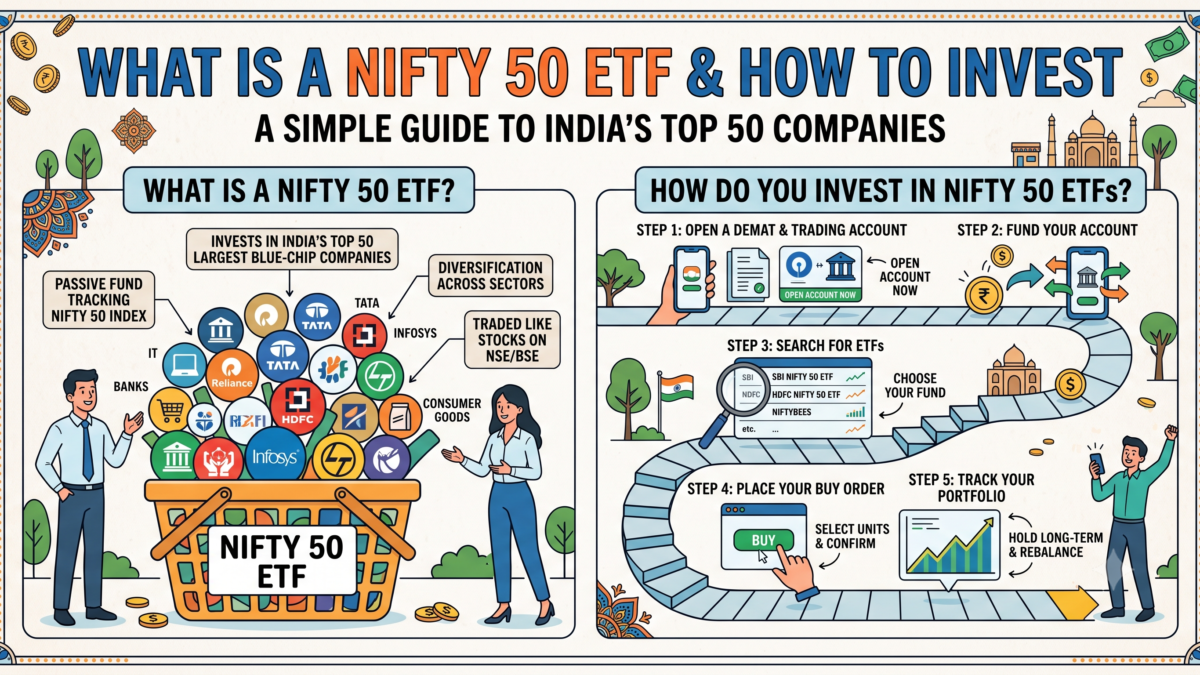
A complete guide to understanding Nifty 50 exchange-traded funds, their key benefits, and the step-by-step process to buy them.
Key points
- A Nifty 50 ETF provides passive exposure to India’s top 50 blue-chip companies listed on the NSE.
- It trades on stock exchanges throughout market hours with real-time pricing, requiring a Demat account.
- Key evaluation criteria include the expense ratio, tracking error, and on-exchange liquidity.
- US and foreign investors face specific tax rules like PFIC regulations or specialized account requirements.
A nifty 50 etf is an exchange-traded fund that passively tracks the Nifty 50 Index, holding the top 50 large-cap companies listed on the National Stock Exchange of India (NSE). It trades directly on stock exchanges throughout market hours just like an individual stock, giving investors instant diversification across India’s premier corporate leaders.
What is a nifty 50 etf and how does it work?
An exchange-traded fund (ETF) is an investment vehicle that pools money from investors to buy a basket of securities. A nifty 50 etf specifically replicates the Nifty 50 Index by purchasing all 50 underlying stocks in the exact weights set by the index provider, NSE Indices Limited.
Unlike traditional open-ended mutual funds that calculate their Net Asset Value (NAV) once at the close of the trading day, ETFs trade continuously during market hours. This liquidity allows investors to buy or sell shares at live market prices throughout the day. Because the fund manager simply replicates the benchmark without actively stock-picking, operating costs remain exceptionally low.
Why invest in the Nifty 50 index?
The Nifty 50 represents approximately 50 to 60 percent of the free-float market capitalization of all stocks listed on the NSE. It spans major economic sectors including financial services, information technology, consumer goods, oil and gas, and metals.
By purchasing a single share of a fund tracking this index, investors gain balanced exposure to the engine of the Indian economy. For long-term investors seeking capital growth, it removes the need to analyze individual balance sheets while providing core exposure to established market leaders.
Key criteria to select a nifty 50 etf
While all funds tracking this benchmark hold the same underlying equities, their performance and trading convenience can vary. Before selecting a scheme, review these critical factors:
- Expense Ratio: The annual management fee charged by the asset management company (AMC). Lower fees ensure a higher portion of returns stays in your portfolio.
- Tracking Error: The annual measure of how closely the fund’s returns follow the actual index. A lower tracking error indicates superior index replication.
- Trading Volume and Liquidity: High daily trading volume on the NSE or BSE ensures tight bid-ask spreads, allowing you to execute trades quickly without paying a premium.
- Impact Cost: The implicit cost incurred while executing an order on the exchange. Lower impact cost reflects deeper liquidity.
How to buy a nifty 50 etf step by step
Investing in exchange-traded index funds requires a few basic operational steps. Follow this simple process to place your first trade:
- Open a Demat and Trading Account: To hold and trade exchange-listed securities in India, open a Demat (Dematerialized) and trading account with a registered stockbroker regulated by the Securities and Exchange Board of India (SEBI).
- Complete Your KYC Verification: Submit your identity proof, address proof, and tax identification details to complete the mandatory Know Your Customer process.
- Fund Your Brokerage Account: Transfer capital from your linked bank account into your trading account via electronic bank transfer or instant payment channels.
- Research and Compare Funds: Look up available funds tracking the index on your broker’s platform. Evaluate their expense ratios, daily trading volume, and liquidity before choosing a nifty 50 etf.
- Place a Buy Order: Search for the fund’s ticker symbol on your broker’s trading portal. Choose between a market order (executes immediately at current price) or a limit order (executes at a specified price or better), enter the number of units, and confirm the trade.
Investing in Indian equities: US vs India rules
The operational and tax rules for buying index products depend heavily on where you reside and where your accounts are established.
For Indian Residents: Investors can buy any domestic nifty 50 etf using local brokerages via their Demat account. Capital gains tax rules apply based on holding periods, distinguishing between short-term capital gains (STCG) and long-term capital gains (LTCG) under Indian Income Tax regulations.
For US Residents and NRIs: Non-Resident Indians (NRIs) can invest in Indian exchange-traded funds through the Portfolio Investment Scheme (PIS) route or direct non-PIS accounts, subject to Reserve Bank of India (RBI) and SEBI guidelines. US-based retail investors without Indian accounts typically gain exposure through US-listed emerging market or India-focused ETFs regulated by the US Securities and Exchange Commission (SEC). Be mindful of US Passive Foreign Investment Company (PFIC) tax rules when US persons invest directly in foreign mutual funds or ETFs.
Frequently asked questions
What is the main difference between a Nifty 50 index fund and an ETF?
An index fund is an open-ended mutual fund bought and sold directly through the fund house at end-of-day NAV. A nifty 50 etf is bought and sold on a stock exchange throughout trading hours at real-time market prices, requiring a Demat account.
Do Nifty 50 ETFs pay dividends?
Yes. Dividends declared by the constituent companies are either reinvested automatically into the fund (in growth variants) or distributed directly to unit holders, depending on the scheme’s structure.
What is the minimum amount required to invest?
You can start by purchasing just one unit of a nifty 50 etf on the stock exchange, making it an accessible option for small retail investors.
This article is for general education and is not investment, tax or financial advice. Rules and figures change — check the official source or a licensed adviser before acting.
This explainer is published by the MoneyPuran desk for general awareness. Rules, limits and rates change over time — please confirm with the official source. Corrections: corrections@moneypuran.com