 Money
Money
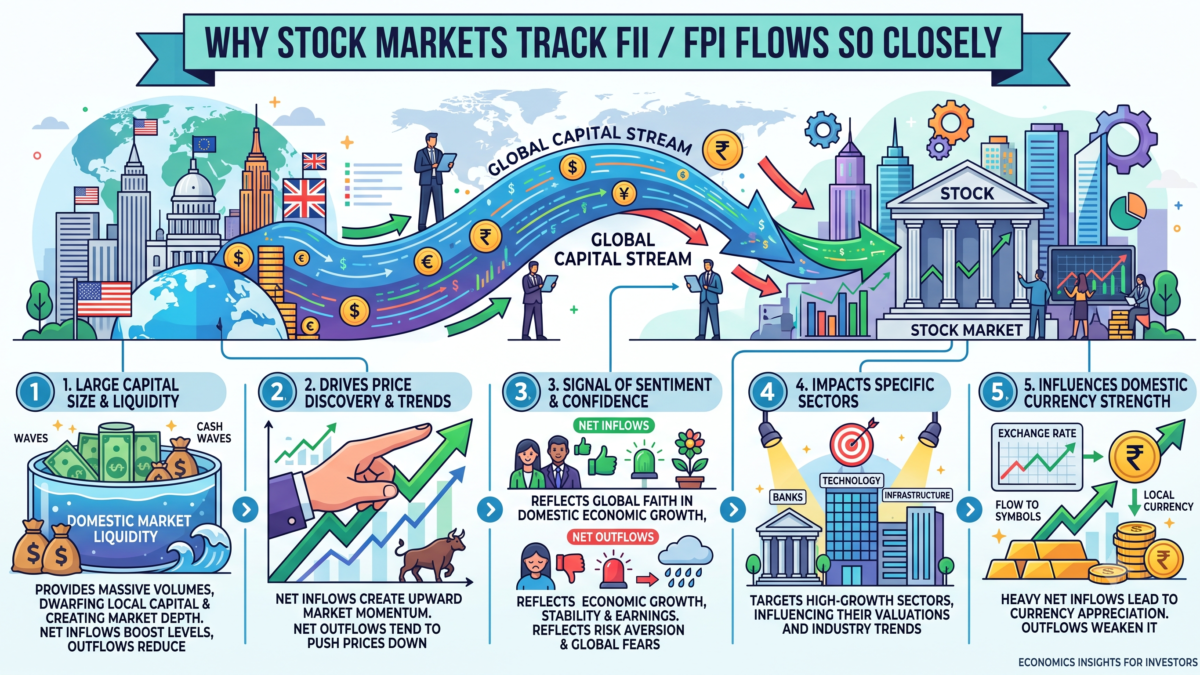
Discover how foreign institutional and portfolio investors move Indian equity markets, how their buying and selling impacts liquidity, and how to track daily capital flows.
Key points
- FPIs are registered foreign institutions investing in Indian stocks and bonds under SEBI regulations.
- Daily net inflows or outflows heavily influence stock market liquidity, major sector valuations, and the rupee exchange rate.
- Domestic Institutional Investors (DIIs) frequently serve as a stabilizing counterweight during sudden foreign capital outflows.
- Key global drivers of institutional capital include US interest rates, treasury yields, global liquidity conditions, and relative emerging market valuations.
Tracking fii fpi flows gives market participants real-time insight into foreign capital movement across Indian equity and debt markets. Foreign Institutional Investors (FIIs) and Foreign Portfolio Investors (FPIs) represent some of the largest pools of capital active in the Indian financial ecosystem. When these global institutions buy or sell aggressively, their transactions frequently determine short-term market trends and impact local currency stability.
Understanding FIIs and FPIs in Indian Financial Markets
The terms Foreign Institutional Investor (FII) and Foreign Portfolio Investor (FPI) are often used interchangeably in financial media. Historically, the Securities and Exchange Board of India (SEBI) categorized foreign market participants separately based on investment structures. To streamline market entry and standardize compliance, regulatory bodies merged these categories under a unified Foreign Portfolio Investor (FPI) framework.
Foreign portfolio investors include international pension funds, sovereign wealth funds, endowment funds, insurance companies, hedge funds, and foreign mutual funds. These entities register with SEBI to allocate funds into listed Indian equities, corporate bonds, government securities, and derivative instruments without taking direct managerial control of Indian corporations.
Why Investors Watch FII FPI Flows Daily
Financial news outlets, equity analysts, and retail traders analyze daily updates on fii fpi flows because foreign capital acts as a key liquidity engine for the stock market. Because global institutions execute trades in large volume blocks, sustained buying usually lifts market benchmarks, whereas continuous selling can trigger market pullbacks.
Institutional trading activity impacts more than just individual stock prices. Foreign capital inflows require global funds to convert US dollars or other currencies into Indian rupees, boosting demand for the local currency. Conversely, rapid capital flight puts downward pressure on the rupee. Analyzing the scale of foreign transactions helps investors assess broader macroeconomic risk appetite.
Key Factors Driving FII FPI Flows
Foreign portfolio managers allocate capital across emerging markets based on a combination of global liquidity conditions and domestic economic indicators. Monitoring these factors helps explain sudden shifts in capital movements across board channels.
- Global Interest Rate Policy: Central bank policies, particularly interest rate decisions by the US Federal Reserve, directly affect global liquidity and risk tolerance.
- US Treasury Yields: Rising yields on risk-free US bonds often prompt international asset managers to reallocate funds away from higher-risk emerging equities back to US dollar debt instruments.
- Relative Market Valuations: If Indian equity price-to-earnings ratios expand significantly compared to other emerging markets like China, Brazil, or South Korea, global managers may rebalance portfolios.
- Domestic Macroeconomic Fundamentals: Strong GDP growth rate, stable inflation metrics, solid corporate earnings performance, and favorable demographic trends attract long-term global capital.
How to Track FII FPI Flows Step by Step
Investors seeking to evaluate institutional market behavior can monitor official institutional activity data published daily by market infrastructure institutions. Understanding how to interpret daily institutional figures helps clarify underlying market strength.
- Access Daily Exchange Summaries: Visit the official web portals of the National Stock Exchange of India (NSE) or the Bombay Stock Exchange (BSE) after market closing hours to inspect daily net buy/sell data for institutional categories.
- Examine Depository Reports: Review monthly and consolidated portfolio holding trends published on the National Securities Depository Limited (NSDL) or Central Depository Services Limited (CDSL) platforms.
- Compare Against DII Activity: Contrast foreign portfolio investment figures with Domestic Institutional Investor (DII) metrics, such as mutual funds and insurance companies, to see if local funds are absorbing foreign selling pressure.
- Evaluate Sector Allocation Data: Monitor periodic sector-wise distribution updates to identify which industries—such as banking, information technology, or infrastructure—foreign investors are actively buying or liquidating.
Foreign Portfolio Investment: US vs India Comparison
Foreign investment mechanics vary significantly depending on local market structures and regulatory jurisdictions. Institutional investors navigating US or Indian markets must observe distinct registration and holding frameworks.
In the United States, foreign investors participate directly in deep capital markets without requiring specialized foreign portfolio investor permits, though non-US entities must comply with specific tax withholding documentation (such as IRS Form W-8BEN-E). In India, foreign institutional participants must register under SEBI guidelines through designated depository participants. While US equity markets rely heavily on domestic retail and institutional investors, tracked fii fpi flows in India carry a proportionally higher influence on daily market liquidity and foreign exchange reserves.
Frequently asked questions
Where can investors check official data for fii fpi flows?
Official daily net purchase and sale statistics are published on the websites of NSE India, BSE India, NSDL, and CDSL. SEBI also periodically releases aggregated statistical reports regarding foreign institutional holdings.
What is the difference between FPI and FDI?
Foreign Portfolio Investment (FPI) involves passive financial investments in listed equities, bonds, or securities without acquiring controlling stakes. Foreign Direct Investment (FDI) involves long-term physical or strategic capital investments in companies, infrastructure, or joint ventures, typically holding significant voting rights or management participation.
How do Domestic Institutional Investors (DIIs) react to foreign selling?
In recent years, strong systematic investment plan (SIP) inflows from domestic retail investors have empowered Indian domestic mutual funds and institutions to buy equities during heavy foreign sell-offs, stabilizing broader equity indices.
This article is for general education and is not investment, tax or financial advice. Rules and figures change — check the official source or a licensed adviser before acting.
Official information: https://www.sebi.gov.in
This explainer is published by the MoneyPuran desk for general awareness. Rules, limits and rates change over time — please confirm with the official source. Corrections: corrections@moneypuran.com