 Money
Money
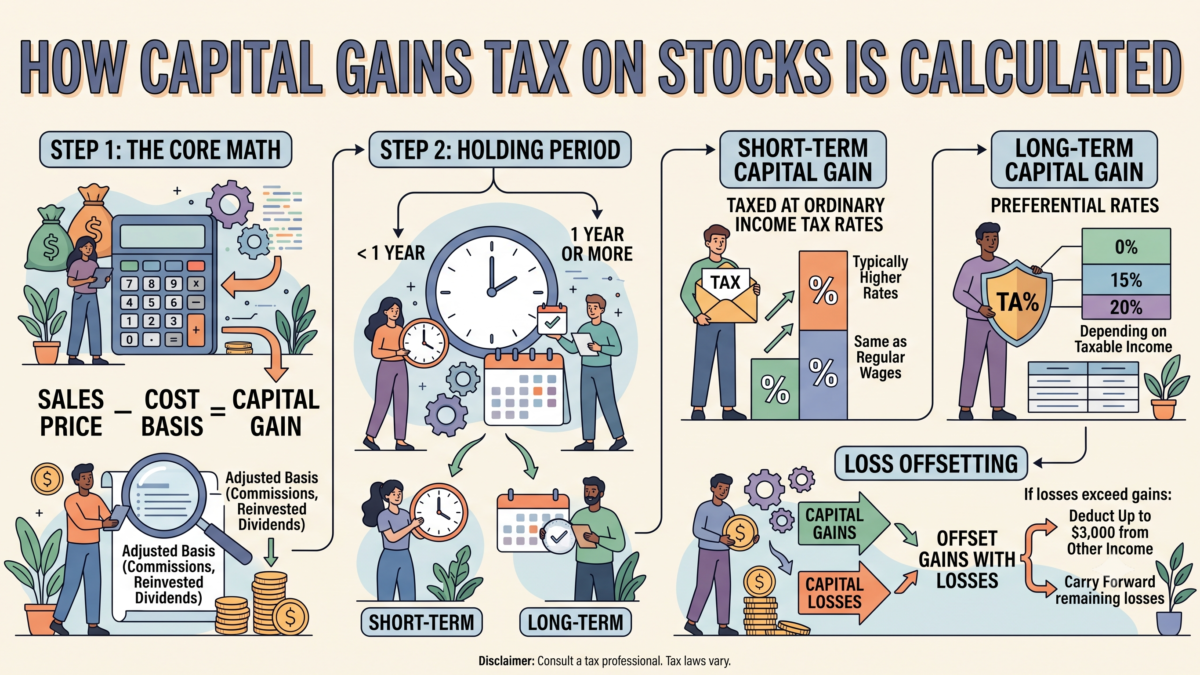
A complete guide to understanding, calculating, and managing capital gains tax on stocks for investors.
Key points
- Capital gains tax is triggered only when you sell stock shares for more than your purchase price.
- Holding periods determine whether gains are classified as short-term or long-term.
- Long-term tax rates are generally lower than short-term rates, rewarding patient investors.
- Capital losses can be used to offset gains through tax-loss harvesting strategies.
Calculating the capital gains tax on stocks is an essential step for any investor looking to keep more of their profits after selling shares. When you invest in the stock market, building wealth is only half the battle. Knowing how the tax code treats your profits ensures you do not face unexpected liabilities when filing your annual return.
What Is Capital Gains Tax on Stocks?
Capital gains tax is a tax imposed on the profit realized from selling a financial asset, such as individual shares, mutual funds, or exchange-traded funds (ETFs). A capital gain occurs when your selling price exceeds your purchase price, also known as your cost basis. If you sell a stock for less than you paid, you incur a capital loss.
It is important to understand that taxes are only owed on realized gains. As long as you hold shares that have increased in value without selling them, your gains remain unrealized paper profits. Once you execute a sell order, that profit becomes taxable. Proper management of your capital gains tax on stocks allows you to optimize overall portfolio efficiency.
Short-Term vs Long-Term Holding Periods
Tax authorities globally divide capital gains into two main categories based on how long you held the asset before selling: short-term and long-term. The threshold between these categories determines the tax rate applied to your profits.
Short-Term Capital Gains
Short-term capital gains apply to assets sold after a short holding period. Because governments encourage patient, long-term investment over rapid trading, short-term gains are typically taxed at higher rates. In many jurisdictions, short-term profits are added directly to your standard annual income and taxed at your ordinary marginal income tax bracket.
Long-Term Capital Gains
Long-term capital gains apply to investments held beyond a designated minimum threshold. Investors who hold assets long-term benefit from preferential, lower tax brackets. This lower rate incentivizes long-term wealth creation and provides a significant advantage to buy-and-hold investors.
How to Calculate Capital Gains Tax on Stocks Step-by-Step
Calculating your tax liability involves a simple mathematical formula, though tracking your purchase records accurately is critical. Follow these key steps to calculate your tax obligation:
- Determine your cost basis: Calculate the total amount paid to acquire the stock, including purchase price, broker commissions, and transaction fees.
- Determine the net sale proceeds: Take the total amount received from selling the stock and subtract any transaction fees or commissions paid during the sale.
- Calculate the capital gain or loss: Subtract your cost basis from the net sale proceeds (Net Sale Proceeds – Cost Basis = Capital Gain or Loss).
- Identify the holding period: Check the exact dates of purchase and sale to classify the gain as either short-term or long-term.
- Apply the relevant tax rate: Multiply your capital gain by the applicable short-term or long-term tax rate for your income bracket.
For instance, if your net profit is determined to be short-term, your final capital gains tax on stocks depends on your overall annual taxable income tier for that tax year.
Key Criteria and Facts to Keep in Mind
When computing your investment taxes, keep the following foundational rules in mind:
- Cost Basis Adjustments: Stock splits, corporate spinoffs, and dividend reinvestment plans (DRIPs) adjust your per-share cost basis over time.
- Tax-Advantaged Accounts: Investments held inside retirement accounts like US 401(k)s, IRAs, or Indian NPS/PPF structures generally grow tax-deferred or tax-free, avoiding immediate capital gains taxes upon sale.
- Tax-Loss Harvesting: Capital losses incurred in a given tax year can offset capital gains, reducing your overall taxable profit dollar-for-dollar.
- Wash-Sale Rules: Selling a stock at a loss and repurchasing the same or substantially identical security within a short window may disallow the loss deduction depending on local regulations.
Capital Gains Tax on Stocks in the US vs India
While the fundamental mechanics of computing gains remain similar, the specific rules for capital gains tax on stocks differ significantly between country tax systems.
United States Framework
In the US, the holding period boundary is exactly one year (365 days). Shares held for one year or less trigger short-term capital gains, taxed as ordinary income. Shares held for more than one year qualify for long-term capital gains tax rates, which sit at lower progressive tiers (typically 0%, 15%, or 20%) depending on your total filing income. Specific rules are outlined on IRS.gov.
India Framework
In India, listed equity shares and equity-oriented mutual funds have a holding period threshold of 12 months. Gains on equity held for 12 months or less are classified as Short-Term Capital Gains (STCG). Gains on equity held for more than 12 months qualify as Long-Term Capital Gains (LTCG). India provides a specific annual threshold of LTCG exemption before tax applies. Specific rate structures and exemption limits are published annually under the Finance Act on incometax.gov.in.
Strategies to Reduce Your Tax Burden
Investors can employ several legal strategies to manage their tax liabilities efficiently. One common strategy is tax-loss harvesting, where you intentionally sell underperforming holdings at a loss to balance out realized gains from successful trades. Additionally, holding assets past the one-year or 12-month mark transitions your gains into lower long-term tax brackets. Finally, utilizing tax-deferred accounts protects your compounding returns from yearly taxation.
Frequently asked questions
Do you pay capital gains tax on stocks if you reinvest the money? Yes. Reinvesting your profits into another stock does not exempt you from tax. The sale of the original stock is a taxable event regardless of what you do with the proceeds afterwards, unless held in a qualified tax-advantaged account.
What happens if you sell stocks at a loss? Selling stocks at a loss creates a capital loss. You can use these losses to offset capital gains realized in the same tax year. If losses exceed gains, tax codes often allow you to carry forward excess losses to future tax years.
How do dividend payments factor into capital gains? Dividends are treated separately from capital gains. Dividend payments are classified as investment income and are subject to dividend tax rules in the year they are received, rather than capital gains rules when shares are sold.
This article is for general education and is not investment, tax or financial advice. Rules and figures change — check the official source or a licensed adviser before acting.
Official information: https://www.irs.gov
This explainer is published by the MoneyPuran desk for general awareness. Rules, limits and rates change over time — please confirm with the official source. Corrections: corrections@moneypuran.com