 Money
Money
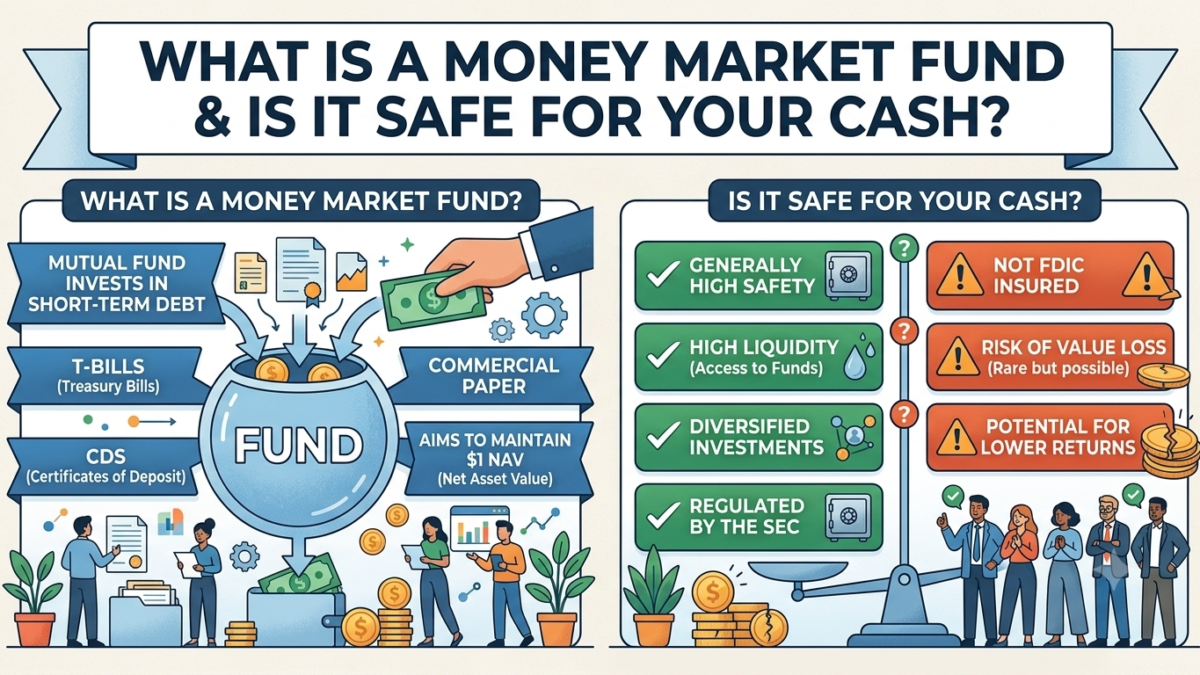
Learn how money market funds work, whether your capital is truly safe, and how investors in the US and India use them for cash management.
Key points
- A money market fund invests in ultra-short-term, high-quality debt like Treasury bills and commercial paper to preserve capital.
- These funds are not bank deposits and lack government deposit insurance, though government-backed versions carry very low default risk.
- In the US, rules aim for a stable $1.00 NAV for retail government funds, while India utilizes daily NAV debt schemes governed by SEBI.
- They serve as ideal vehicles for emergency funds, short-term reserves, or temporary cash parking.
A money market fund is a specialized type of mutual fund that invests in high-quality, ultra-short-term debt instruments to provide capital preservation and liquidity.
Investors frequently use these funds as a high-yield alternative to traditional checking or savings accounts. While they are designed to maintain a stable value and offer easy access to your cash, understanding their underlying mechanics and safety features is critical before depositing your reserves.
How a money market fund works
When you invest in a money market fund, your money is pooled with capital from other investors to buy short-term debt securities issued by governments, financial institutions, and major corporations. These holdings typically include Treasury bills, certificates of deposit, commercial paper, and repurchase agreements with maturities ranging from a few days to several months.
Because the underlying assets mature so quickly, the fund experiences minimal price sensitivity to interest rate changes. In the United States, retail and government funds operate with the goal of maintaining a constant Net Asset Value (NAV) of $1.00 per share. The net income earned from the underlying debt is accumulated and distributed to shareholders as monthly dividend yields.
Is a money market fund safe?
Evaluating whether a money market fund is safe requires understanding the subtle difference between investment safety and statutory protection. These products are generally considered among the safest investments available on the financial market, but they are not entirely risk-free.
Unlike standard bank savings accounts, holding a money market fund does not entitle you to government deposit insurance, such as FDIC coverage in the US or DICGC protection in India. If an underlying issuer defaults, the fund could theoretically suffer losses—an event known as ‘breaking the buck’ if the share price drops below $1.00. However, regulatory frameworks enforced by central financial authorities make major credit defaults within government-oriented funds exceptionally rare.
Comparing options in the United States and India
The operational framework for cash management funds varies depending on your jurisdiction, though the core objective remains the same across global markets.
- United States: Regulated by the SEC under Rule 2a-7, US options fall into three main buckets: Government funds (investing primarily in US Treasuries and agency debt), Prime funds (investing in corporate commercial paper), and Tax-Exempt funds (investing in municipal bonds). Government funds carry virtually zero credit risk and maintain a stable $1.00 NAV.
- India: Regulated by SEBI, Indian asset management companies offer designated Money Market Funds and Liquid Funds. Rather than maintaining a fixed NAV, these open-ended debt schemes calculate a daily floating NAV based on mark-to-market pricing of debt securities maturing within 91 days (for liquid funds) or up to one year (for money market funds).
Key features to evaluate before investing
Before allocating your emergency fund or institutional cash reserves, compare offerings using a structured checklist of essential criteria:
- Underlying Asset Backing: Verify whether the portfolio holds government-backed Treasuries or higher-yielding corporate commercial paper.
- Expense Ratio: Lower annual management fees directly increase the net yield passed on to you.
- Weighted Average Maturity (WAM): Shorter average portfolio maturities reduce interest rate risk.
- Liquidity Rules: Check redemption settlement timelines (typically T+0 or T+1 business days) and any applicable exit loads or redemption gates.
How to choose the right money market fund: Step by step
- Identify your objective: Determine if you need an operational emergency cash cushion or a temporary holding station for upcoming large purchases.
- Assess your risk tolerance: Choose a government-focused fund if absolute capital safety is your goal, or a prime fund if you seek a slightly higher yield in exchange for corporate credit exposure.
- Check expense ratios: Compare management costs across fund families, as high expense fees erode net interest earnings in low-yield environments.
- Review regulatory disclosures: Visit official regulator websites or the fund manager’s portal to check liquidity buffers and historical yield stability.
- Execute the purchase: Open an account through a direct mutual fund platform, direct AMC portal, or discount brokerage to purchase shares.
Frequently asked questions
Is a money market fund insured like a bank account? No, these funds are investment products and are not insured by the FDIC or DICGC. However, government-focused options hold securities backed by the full faith and credit of the sovereign state.
Can you lose money in a money market fund? While extreme credit events or market panics can theoretically cause a fund to lose value, modern regulatory guardrails require substantial liquidity buffers to prevent capital loss under normal conditions.
How does it differ from a money market deposit account? A deposit account is an interest-bearing bank account insured by government deposit insurance. A mutual fund version is an investment portfolio of short-term debt instruments traded through investment brokerages or fund platforms.
This article is for general education and is not investment, tax or financial advice. Rules and figures change — check the official source or a licensed adviser before acting.
Official information: https://www.investor.gov
This explainer is published by the MoneyPuran desk for general awareness. Rules, limits and rates change over time — please confirm with the official source. Corrections: corrections@moneypuran.com