 Money
Money
Learn how smart asset allocation, low-cost index funds, and periodic rebalancing protect your capital while driving steady long-term market growth.
Key points
- Diversification spreads risk across asset classes, market sectors, and geographic regions.
- Low-cost index funds and ETFs provide immediate exposure to thousands of assets at minimal cost.
- Your personal mix of stocks, bonds, and cash should match your time horizon and risk tolerance.
- Periodic rebalancing keeps your risk profile on target as asset prices change over time.
A diversified portfolio is the foundational building block of long-term financial stability and wealth creation. Rather than placing all your capital into a single stock or sector, diversification spreads your money across various investment types to minimize exposure to any single market drop. While it cannot guarantee protection against market losses, a structured asset allocation helps smooth out performance swings and supports steady long-term growth.
What is a diversified portfolio?
Understanding how a diversified portfolio works begins with the concept of asset correlation. Different investments respond differently to economic changes. For example, when inflation rises or economic growth slows, individual corporate shares may fall while government bonds, cash instruments, or physical commodities hold firm or increase in value.
When you hold a well-balanced investment mix, you blend assets that do not move in lockstep with one another. The primary goal is not to maximize short-term speculative returns, but to achieve optimal risk-adjusted returns over your investment horizon. By managing risk, you stay invested during market downturns rather than making emotional decisions to panic-sell.
Core components of a resilient strategy
A comprehensive investment mix generally balances growth investments with capital preservation assets. Depending on your age, financial goals, and personal risk comfort, your portfolio will lean more heavily toward equities or fixed income.
Key asset classes to consider include:
- Equities (Stocks): Driving long-term capital appreciation, this includes domestic and international stocks across large, mid, and small market capitalizations.
- Fixed Income (Bonds): Provides predictable income and price stability, often acting as a buffer when stock markets experience downturns.
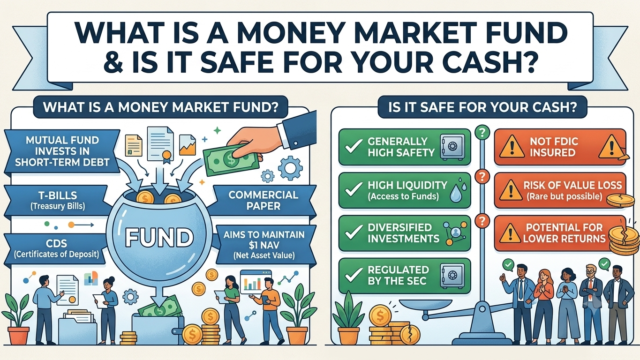
- Cash and Equivalents: High-yield savings accounts, short-term treasury bills, and money market funds offer liquidity and immediate safety for unexpected needs.
- Real Assets: Commodities such as gold and Real Estate Investment Trusts (REITs) offer an inflation hedge and low correlation to traditional equities.
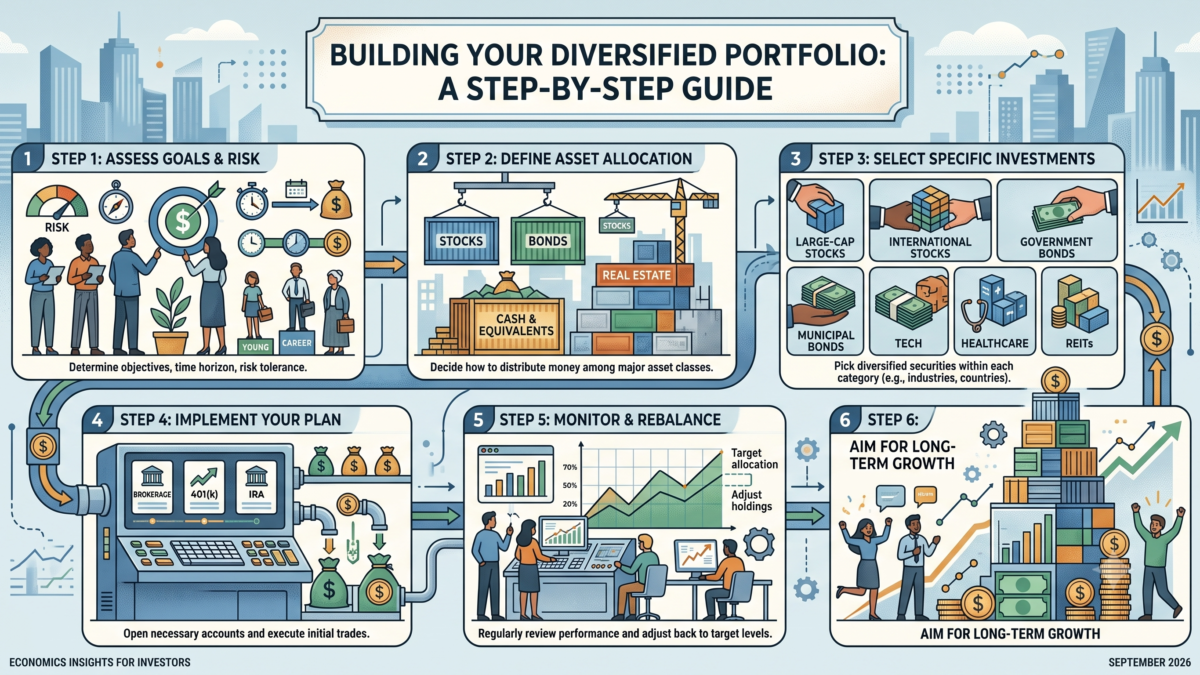
Step-by-step guide to building a diversified portfolio
Structuring your investment allocation does not require hand-picking individual stocks or attempting to predict economic cycles. Using low-cost, broad-market index funds or exchange-traded funds (ETFs) allows you to own thousands of assets instantly with very low management fees.
- Define your financial goals and timeline: Clarify when you will need to withdraw the funds. Money needed within three years belongs in stable, liquid assets, whereas capital meant for retirement twenty years away can take on higher equity exposure.
- Determine your risk tolerance: Be realistic about how much market volatility you can handle without selling during a crash. Higher equity shares mean higher potential return but greater short-term volatility.
- Select your target asset allocation: Establish specific percentages for each asset class, such as an 80% stock and 20% bond split for long-term aggressive growth, or a 50/50 split for conservative income.
- Select broad-market index funds: Choose low-expense funds that track major domestic equity indices, international equity markets, and high-quality bond markets to instantly build your mix.
- Automate regular contributions: Set up automated transfers from your checking account to purchase your index funds consistently regardless of market trends.
US vs India: Implementing your asset mix
While the economic theory remains constant, the practical implementation of a diversified portfolio depends on your home country’s account structures and regulatory systems.
In the United States, investors typically construct their holdings inside tax-advantaged accounts such as 401(k) plans, Traditional or Roth IRAs, and Health Savings Accounts (HSAs). Core equity options usually track broad benchmarks like the S&P 500 or Total Stock Market index. Standard contribution limits and rules are published annually by the Internal Revenue Service (IRS).
In India, investors build their portfolio through mutual fund Systematic Investment Plans (SIPs), Public Provident Fund (PPF), National Pension System (NPS), and direct equities via Demat accounts. Broad equity holdings frequently target the Nifty 50 or Sensex, supplemented by Sovereign Gold Bonds (SGBs) and debt mutual funds. Regulations and tax guidelines are established by the Securities and Exchange Board of India (SEBI) and the Income Tax Department.
Rebalancing and managing risk over time
As market prices fluctuate, your portfolio’s actual asset mix will drift away from your original target percentages. For example, during a prolonged bull market, your stock investments may grow faster than your bonds, pushing an intended 70% stock allocation up to 85% and accidentally exposing you to higher risk.
To correct this, you must rebalance your holdings periodically. You can rebalance on a scheduled calendar basis—such as once per year—or whenever a specific asset class strays more than 5% from its original target percentage. Rebalancing encourages disciplined investing by prompting you to lock in gains from top performers and buy lagging assets at lower prices.
Frequently asked questions
Is buying ten different technology stocks considered a diversified portfolio? No. Holding multiple companies within the same sector leaves you exposed to industry-specific regulatory and economic risks. A broad allocation requires spreading capital across different sectors, market sizes, asset classes, and geographic regions.
How often should I rebalance my portfolio? Most investors need to rebalance only once a year or when asset targets shift by 5% or more. Rebalancing too frequently can generate unnecessary transaction charges and trigger tax consequences.
Can broad index funds handle all my diversification needs? Yes. A simple index fund strategy—often referred to as a three-fund portfolio consisting of a domestic stock fund, an international stock fund, and a bond market fund—delivers complete global market coverage at a fraction of the cost of active fund management.
This article is for general education and is not investment, tax or financial advice. Rules and figures change — check the official source or a licensed adviser before acting.
Official information: https://www.investor.gov
This explainer is published by the MoneyPuran desk for general awareness. Rules, limits and rates change over time — please confirm with the official source. Corrections: corrections@moneypuran.com