 Money
Money
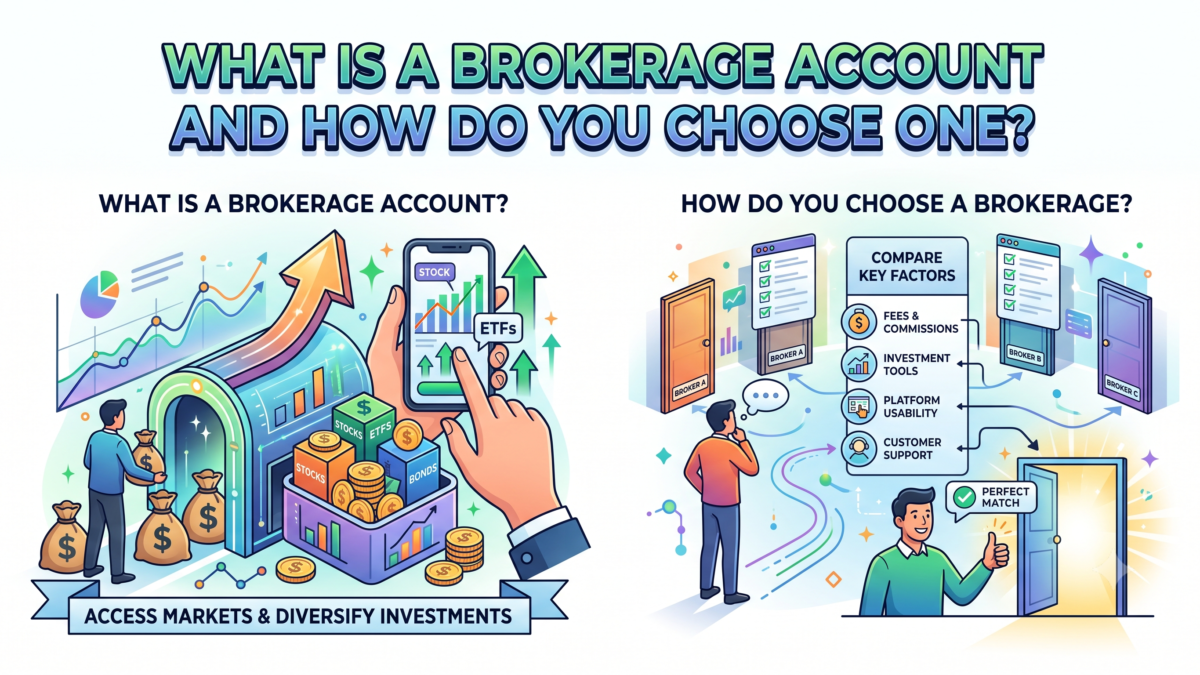
Understand how brokerage accounts work, what fees to watch for, and how to choose the best trading platform for your financial goals.
Key points
- A brokerage account allows retail investors to buy and sell securities like stocks, ETFs, and bonds.
- Comparing brokers requires looking beyond headline trade commissions to account minimums, platform tools, and hidden fees.
- US investor assets are protected under SEC/FINRA regulations with SIPC coverage, while Indian investors rely on SEBI-registered brokers and Demat depositories.
- Selecting the right broker depends on your investment strategy, required research tools, and desired level of customer support.
A brokerage account is an arrangement between an investor and a licensed financial firm that allows you to purchase, store, and sell investment assets online or through an adviser. Whether you want to invest in individual equities, index funds, government bonds, or exchange-traded funds (ETFs), this account serves as your operational gateway to capital markets. Unlike a traditional bank deposit account designed for daily spending and fixed interest, these accounts hold market assets that carry principal risk but offer potential long-term growth.
What is a brokerage account and how does it work?
At its core, a brokerage account acts as an intermediary between retail investors and public stock exchanges. When you deposit cash into your account, you can submit order instructions to purchase financial securities. The brokerage executes those orders on the open market and holds custody of the resulting assets on your behalf.
Investors typically choose between taxable investment accounts and tax-advantaged accounts. Taxable accounts provide complete flexibility, allowing you to deposit or withdraw funds at any time without penalty. However, realized capital gains and interest income within the account are subject to annual taxes. Tax-advantaged options—such as Individual Retirement Accounts (IRAs) in the United States or National Pension System (NPS) accounts in India—offer tax benefits but impose specific contribution rules and withdrawal restrictions.
Key features to compare in a brokerage account
Choosing where to open your account requires evaluating how a firm’s feature set matches your trading style. Beginners often prioritize low minimum deposits and intuitive mobile app interfaces, whereas active traders demand fast order execution, advanced charting tools, and direct market access. Consider these critical criteria when reviewing options:
- Commission structures and hidden fees: Look beyond zero-commission stock headlines. Pay attention to options contract fees, margin interest rates, transfer charges, account inactivity fees, and currency conversion markups.
- Account minimums: Many modern discount platforms require zero initial balance to open an account, while full-service wealth firms or specialized platforms may require a higher starting deposit.
- Asset selection: Confirm that the firm grants access to the specific product categories you intend to trade, including domestic stocks, international equities, fixed-income bonds, and mutual funds.
- Platform reliability and tools: Look for stable server uptime, clean portfolio tracking tools, real-time market quotes, and embedded educational resources.
- Customer support responsiveness: Evaluate whether the broker provides live chat, local branch access, or prompt telephone support during market hours.
Step by step: How to choose and open a broker
Selecting the proper platform requires a clear methodology so you do not encounter unexpected costs or regulatory issues later. Follow this structured approach to select the right partner for your needs:
- Define your financial strategy: Decide whether you plan to build a hands-off, long-term portfolio of index funds or actively trade stocks and derivative options throughout the week.
- Calculate total cost of ownership: Review the complete fee schedule for non-trading costs, including wire fees, paper statement charges, and indirect costs like payment for order flow execution quality.
- Verify regulatory credentials: Confirm that the firm is officially registered with primary market regulators in your country before transferring money.
- Test the software user interface: Take advantage of virtual demo accounts or explore the mobile application layout to ensure order placement feels comfortable and logical.
- Fund your brokerage account: Link your primary bank account securely, complete mandatory Know Your Customer (KYC) identity documentation, and execute your initial order.
US vs India: Key regulatory and account differences
While the basic objective remains identical worldwide, the regulatory structure of a brokerage account varies by country.
In the United States, investment platforms are governed by the Securities and Exchange Commission (SEC) and the Financial Industry Regulatory Authority (FINRA). Non-bank cash balances and securities are generally protected against firm insolvency by the Securities Investor Protection Corporation (SIPC) up to legal coverage thresholds. US investors frequently choose between cash accounts (where trades are funded entirely with clear money) and margin accounts (which permit borrowing against portfolio equity).
In India, capital markets are overseen by the Securities and Exchange Board of India (SEBI). Indian investors open a trading account with a SEBI-registered stockbroker to place transactions, paired with a Demat (dematerialized) account maintained by central depositories such as NSDL or CDSL to hold securities electronically. Many Indian banking institutions provide integrated 3-in-1 accounts that seamlessly link a savings account, trading account, and Demat account.
Frequently asked questions
Is my money safe in a brokerage account? Brokerage accounts are protected by regulatory safeguards against broker insolvency, but these protections do not protect your portfolio value from normal stock market price drops and investment losses.
Can I open more than one brokerage account? Yes, investors are allowed to maintain accounts across multiple financial institutions to access varied research tools, separate trading strategies, or distribute counterparty risk.
What is the difference between a cash account and a margin brokerage account? A cash account requires you to pay for all securities in full using available cash, whereas a margin account allows you to borrow capital from the broker using your existing assets as loan collateral.
How much capital do I need to start investing? Many contemporary brokers have no minimum account balance requirements and support fractional shares, making it possible to begin investing with modest initial amounts.
This article is for general education and is not investment, tax or financial advice. Rules and figures change — check the official source or a licensed adviser before acting.
Official information: https://www.investor.gov
This explainer is published by the MoneyPuran desk for general awareness. Rules, limits and rates change over time — please confirm with the official source. Corrections: corrections@moneypuran.com