 Money
Money
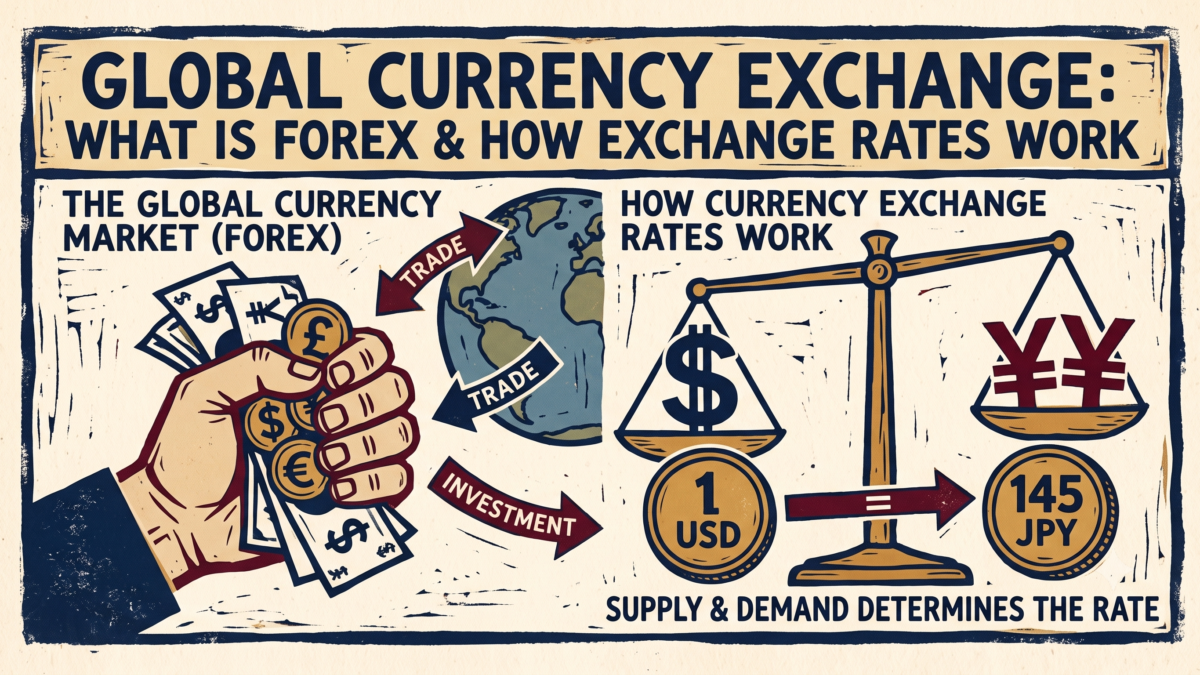
A complete guide to the global foreign exchange market, currency pairs, leverage risks, and how central banks drive exchange rates.
Key points
- Forex (FX) is the decentralized global market where national currencies are traded in pairs such as EUR/USD or USD/INR.
- Exchange rates move due to interest rate differentials, inflation, economic growth, trade balances, and geopolitical risk sentiment.
- Retail foreign exchange trading involves heavy leverage, which significantly increases potential losses alongside potential gains.
- US retail traders face a 50:1 leverage cap under CFTC/NFA rules, while Indian residents are restricted to RBI/SEBI-approved exchange-traded derivatives.
What Is Forex and How Does the FX Market Work?
Understanding what is forex is essential for anyone interested in global finance, international trade, or financial markets. Short for foreign exchange (or FX), forex is the decentralized global marketplace where national currencies are traded against one another. Unlike stock exchanges that operate in a single physical location, foreign exchange trading happens electronically over-the-counter (OTC) through a global network of banks, brokers, institutions, and individual traders 24 hours a day during the workweek.
Currencies are always quoted in pairs, such as EUR/USD or USD/INR. The first currency in the pair is the base currency, while the second is the quote currency. When you buy a currency pair, you are buying the base currency and selling the quote currency simultaneously. The exchange rate reflects how much of the quote currency is required to buy one unit of the base currency.
Key Features of the Foreign Exchange Market
When exploring what is forex, beginner investors should familiarize themselves with the core mechanics that separate currency markets from traditional stock markets.
- 24-Hour Market: FX trading moves across major financial hubs from Sydney to Tokyo, London, and New York continuously from Sunday evening to Friday evening.
- Massive Liquidity: The foreign exchange market is the largest financial market in the world, processing trillions of dollars in daily transaction volume.
- Currency Pairs: Trading is organized into majors (e.g., EUR/USD, GBP/USD), minors, and exotic pairs involving emerging market currencies.
- Over-the-Counter Structure: There is no single centralized exchange; prices are quoted by major market-making financial institutions globally.
- High Leverage: Forex brokers often offer significant leverage, which amplifies both potential profits and potential losses.
Why Rates Move: Key Drivers of Currency Values
Exchange rates fluctuate constantly based on supply and demand dynamics across the global financial system. When demand for a country’s currency rises relative to its supply, that currency appreciates in value.
Several macroeconomic factors directly influence currency movements:
1. Interest Rate Differentials
Central bank monetary policy is the single biggest driver of exchange rates. When a central bank raises interest rates, higher yields attract foreign capital, boosting demand for that currency. Conversely, lowering interest rates tends to weaken a currency as investors seek higher yields elsewhere.
2. Inflation Rates
Countries with consistently lower inflation rates typically experience an appreciation in their currency’s purchasing power relative to currencies with higher inflation rates.
3. Trade Balances and Economic Growth
A country exporting more goods than it imports has a trade surplus, which increases foreign demand for its currency. Strong Gross Domestic Product (GDP) growth also attracts direct foreign investment.
4. Market Sentiment and Risk Appetite
During periods of global market stress or geopolitical uncertainty, investors often seek “safe-haven” currencies like the US Dollar (USD), Swiss Franc (CHF), or Japanese Yen (JPY). The US Dollar Index (DXY) is frequently monitored to measure the greenback’s strength against a weighted basket of six major world currencies.
Step-by-Step: How a Currency Trade Functions
To better grasp what is forex execution in practice, consider how a typical currency pair trade takes place in a trading account.
- Select a Currency Pair: A trader evaluates economic data and chooses a pair, such as EUR/USD.
- Analyze the Trend: The trader decides whether the base currency (EUR) will strengthen or weaken against the quote currency (USD).
- Determine Trade Size and Leverage: The position size is selected. Borrowed capital (leverage) allows control of a larger position with a smaller margin deposit.
- Place the Order: The trader executes a “Buy” (Long) order if expecting the base currency to rise, or a “Sell” (Short) order if expecting it to fall.
- Manage and Close the Position: Stop-loss and take-profit orders help manage risk until the position is closed to lock in a profit or loss.
US vs India: Regulatory Differences for Forex Traders
Regulations governing currency trading differ significantly depending on where you reside. When evaluating what is forex participation options, investors must comply strictly with local financial laws.
In the United States, foreign exchange trading is regulated by the Commodity Futures Trading Commission (CFTC) and the National Futures Association (NFA). Retail traders can trade a wide array of global spot currency pairs through registered Forex Commission Merchants (FCMs), though leverage for major pairs is capped at 50:1 to protect retail accounts from extreme volatility.
In India, retail participation in spot off-exchange forex is strictly restricted by the Reserve Bank of India (RBI) under the Foreign Exchange Management Act (FEMA). Indian residents are not permitted to send money abroad via the Liberalised Remittance Scheme (LRS) to trade margin forex on overseas platforms. Instead, retail currency trading in India is limited to standardized exchange-traded currency derivatives (futures and options) on domestic exchanges like the NSE and BSE, primarily involving approved INR currency pairs (such as USD/INR, EUR/INR, GBP/INR, JPY/INR) and select cross-currency contracts.
Understanding the Risks of Forex Leverage
While the foreign exchange market offers high liquidity and accessibility, it carries significant financial risk. Leverage acts as a double-edged sword: while a 30:1 or 50:1 leverage ratio can magnify modest percentage gains, a slight adverse move in exchange rates can wipe out a trader’s entire initial margin deposit rapidly.
Professional traders emphasize risk management techniques, such as risking only a small percentage of total portfolio capital on any single trade, maintaining strict stop-loss limits, and avoiding unapproved overseas brokers that operate outside regulatory oversight.
Frequently Asked Questions
What is forex trading leverage and how does it work? Leverage allows traders to control larger trade sizes with a fraction of the actual capital as a margin deposit. While leverage can increase capital efficiency, it exponentially increases risk and potential loss.
What is the US Dollar Index (DXY)? The US Dollar Index (DXY) measures the value of the US Dollar relative to a weighted basket of major foreign currencies, including the Euro, Japanese Yen, British Pound, Canadian Dollar, Swedish Krona, and Swiss Franc.
Can retail traders trade forex legally in India? Retail residents in India can legally trade currency futures and options listed on SEBI-regulated exchanges (NSE, BSE) for authorized currency pairs. Overseas margin forex trading on unauthorized electronic platforms is illegal under RBI and FEMA regulations.
What causes sudden swings in currency exchange rates? Unexpected interest rate decisions by central banks, surprise inflation readings, geopolitical events, and sudden shifts in global market risk sentiment are the primary causes of volatile exchange rate swings.
This article is for general education and is not investment, tax or financial advice. Rules and figures change — check the official source or a licensed adviser before acting.
Official information: https://www.investor.gov
This explainer is published by the MoneyPuran desk for general awareness. Rules, limits and rates change over time — please confirm with the official source. Corrections: corrections@moneypuran.com