 Money
Money
Understand how the monthly nonfarm payrolls, unemployment rate, and wage growth data drive global stock markets and central bank policy.
Key points
- The US jobs report is published monthly by the Bureau of Labor Statistics and includes nonfarm payrolls, unemployment, and wage growth.
- Federal Reserve policymakers closely monitor employment data to decide whether to adjust or hold benchmark interest rates.
- Strong job gains can trigger rate-hike fears, while weak hiring can signal economic slowing or rate cut expectations.
- Global markets, including Indian equities and foreign exchange rates, often react instantly to US employment surprises.
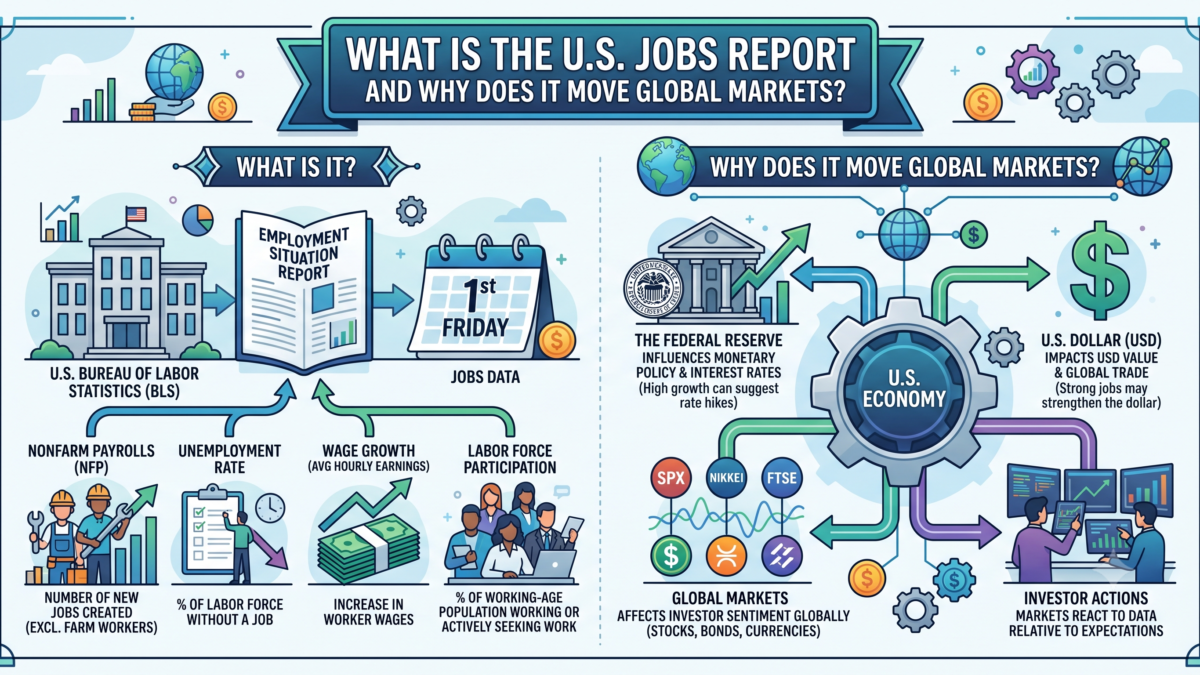
The us jobs report is one of the most influential economic releases in global finance, capable of triggering instant volatility across stock markets, bond yields, and currency exchanges. Officially titled the Employment Situation report, it is published on the first Friday of every month by the U.S. Bureau of Labor Statistics (BLS).
What Is the US Jobs Report?
The us jobs report provides a comprehensive snapshot of the labor market in the United States during the previous month. It relies on two separate surveys: the Establishment Survey, which gathers data from thousands of businesses and government agencies, and the Household Survey, which interviews individual households across the country.
Because consumer spending drives roughly two-thirds of the American economy, the health of the labor market directly reflects the broader momentum of economic growth. When businesses are hiring and wages are growing, consumers spend more money, boosting corporate revenues and overall economic output.
Key Components of the Monthly Labor Release
When financial media and Wall Street analysts review the monthly data, they focus on four critical metrics that outline employment health and wage pressure:
- Nonfarm Payrolls (NFP): The total number of paid U.S. workers added or lost in the previous month, excluding farm workers, private household employees, and government employees.
- Unemployment Rate: The percentage of the active labor force that is unemployed and actively seeking work during the survey week.
- Average Hourly Earnings: A measure of wage growth that signals wage push inflation. Faster wage growth increases purchasing power but can also fuel overall price pressures.
- Labor Force Participation Rate: The percentage of the working-age population that is either employed or actively looking for a job.
Why the US Jobs Report Moves Global Markets
The main reason the us jobs report causes sharp market swings is its direct link to Federal Reserve monetary policy. The Federal Reserve operates under a dual mandate from the U.S. Congress: achieving maximum sustainable employment and maintaining stable prices (controlling inflation).
When the us jobs report shows unexpectedly strong payroll growth and rising wages, investors worry that the economy may be overheating. Strong labor demand can force the Fed to raise interest rates or keep them higher for longer to cool inflation. High interest rates tend to lower stock valuations, increase borrowing costs for companies, and strengthen the U.S. Dollar.
Conversely, if the report reveals weak job creation or rising unemployment, it suggests economic slowdown or potential recession. While weak data can hurt stock prices in the short term due to earnings fears, it often sparks market rallies if investors expect the Fed to cut interest rates to stimulate the economy.
How to Analyze the US Jobs Report
Investors can evaluate the release systematically by comparing headline figures against consensus market expectations. Here is how institutional traders process the data:
- Check Headline Payrolls vs Forecasts: Compare the actual nonfarm payroll additions against Wall Street consensus estimates to identify negative or positive surprises.
- Inspect Wage Growth Figures: Look at month-over-month and year-over-year percentage changes in average hourly earnings to assess inflationary pressures.
- Review Prior Month Revisions: Examine whether data from the previous two months was revised upward or downward, which alters the underlying economic trend.
- Assess the Unemployment and Participation Rates: Determine if a drop in unemployment was driven by real job gains or people leaving the labor force altogether.
US vs India Employment Indicators
The global impact of American employment figures extends far beyond domestic borders, affecting international markets like India’s National Stock Exchange (NSE) and Bombay Stock Exchange (BSE). Strong U.S. employment figures often push U.S. Treasury yields higher, causing foreign portfolio investors (FPIs) to temporarily pull capital out of emerging markets like India.
However, the economic reporting structure differs significantly between the two nations. While the us jobs report is released monthly on a strict schedule, Indian labor market tracking relies on multiple periodic sources. India’s Ministry of Statistics and Programme Implementation (MoSPI) publishes the Periodic Labour Force Survey (PLFS), complemented by monthly payroll additions reported by the Employees’ Provident Fund Organisation (EPFO). Unlike the Fed, the Reserve Bank of India (RBI) focuses primarily on consumer price index (CPI) inflation and domestic GDP metrics when setting policy interest rates.
Frequently asked questions
When is the US jobs report released? The U.S. Bureau of Labor Statistics typically releases the report on the first Friday of every month at 8:30 AM Eastern Time.
Why is wage growth so important in the jobs report? Wage growth measures how quickly pay is rising. Rapid wage increases boost household income but can also force businesses to raise prices, contributing to persistent inflation that prompts central banks to raise interest rates.
How does the report affect equity investors in India? A stronger-than-expected report can lead to higher U.S. interest rates and a stronger U.S. Dollar, which can trigger short-term capital outflows from Indian equities as global investors seek higher risk-free yields in U.S. Treasuries.
What does a revision to nonfarm payrolls mean? Initial monthly payroll estimates are based on early survey responses. In subsequent months, the Bureau of Labor Statistics updates these numbers with additional data, offering a clearer picture of historical employment trends.
This article is for general education and is not investment, tax or financial advice. Rules and figures change — check the official source or a licensed adviser before acting.
Official information: https://www.federalreserve.gov
This explainer is published by the MoneyPuran desk for general awareness. Rules, limits and rates change over time — please confirm with the official source. Corrections: corrections@moneypuran.com