📅 Wednesday, 09 September 2026 🌍 Markets · Business · Investing — every session
SENSEX -- --
NIFTY 50 -- --
NIFTY BANK -- --
USD/INR -- --
GOLD -- --
CRUDE OIL -- --
BTC/USD -- --
Stocks

What Is Options Trading and Why Is It Risky?

Master options trading fundamentals in 2026. Learn how call and put contracts work, why leverage creates high risk, and what retail traders face.

 · 
| 🕐 6 min read
Share:
Advertisement
Ad Slot 728x90

A clear, foundational breakdown of options contracts, how leverage works, and why most retail participants face significant financial risks.

Table of Contents

The Mechanics of Options Contracts

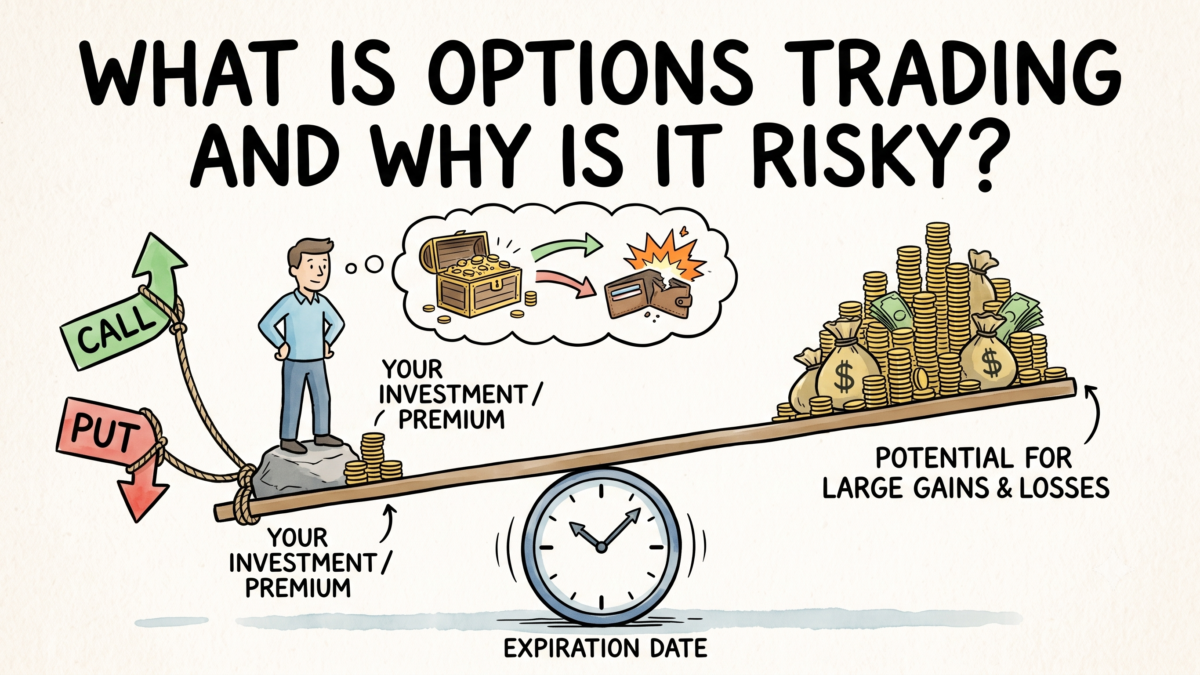
An option is a financial contract that provides the buyer with a specific right. This right allows you to buy or sell a specific underlying asset at a predetermined price, known as the strike price.
Crucially, you have the right to execute this trade within a specific timeframe, but you never have the obligation to do so. Options are broadly categorized into two primary types: calls and puts.
To obtain these trading rights, the buyer must pay a non-refundable upfront fee to the seller. This fee is called a premium.
The cost of this premium is constantly changing. It is driven by market volatility, the amount of time remaining until expiration, and how close the current asset price is to the strike price.
It is also important to note that options do not pay regular corporate dividends. This is because the contract holder does not actually own the underlying shares directly.

Call Options: Betting on a Price Rise

A call option gives the holder the right to buy an asset at a set strike price before the expiration date. Buyers of call options are betting that the asset’s price will rise significantly.
Example Trade:
  • The Setup: Imagine Stock X is currently trading at $50. You believe the price will increase next month.
  • The Trade: You execute an order to buy a call option with a strike price of $55. It expires in one month and costs a premium of $2 per share.
  • The Cost: Since standard stock option contracts control 100 shares, your total premium paid is $200. This $200 is your maximum potential loss.
  • The Result (Win): Stock X jumps to $65 before expiration. You exercise your right to buy the shares at your $55 strike price. You can immediately sell them at the $65 market price, netting a $10 profit per share. After subtracting your $2 premium, your total profit is $800.
  • The Result (Loss): Stock X stays at $50. The contract expires completely worthless, and you lose your initial $200 premium.

Put Options: Betting on a Price Fall

A put option gives the holder the right to sell an asset at a set strike price. Buyers of put options are betting that the asset’s price will fall.
Example Trade:
  • The Setup: Stock Y is trading at $100. You believe an upcoming earnings report will be poor, causing the price to drop.
  • The Trade: You buy a put option with a $90 strike price for a $3 premium. This costs you $300 total.
  • The Result (Win): Stock Y crashes to $70. You now have the right to sell the stock at $90, even though the open market price is only $70.
  • The Profit: This yields a $20 per share advantage. After subtracting your $3 premium, your total profit is $1,700.
  • The Result (Loss): Stock Y rises to $110. The option vanishes upon expiry since the market did not move favorably, resulting in a total loss of your $300 premium.

Why Options Carry Extreme Risk

Options attract retail participants largely because of leverage. A relatively small premium allows a trader to control a much larger block of shares.
This means potential percentage gains can look staggering. However, this exact same leverage magnifies losses rapidly.
Time Decay
Unlike purchasing traditional stocks that can be held indefinitely during a market downturn, options have a strict expiration date. As each day passes, the time value of the contract erodes. This works directly against the buyer.
Implied Volatility
This metric reflects the market’s forecast of how much an asset’s price is likely to move. Higher volatility increases option premiums, making the contracts more expensive to purchase upfront. If volatility drops after you buy, the option loses value even if the stock price remains stable.
Infinite Seller Risk
While buyers can only lose the premium paid, sellers (writers) of options face a much harsher reality. An unhedged (or “naked”) option seller can face substantial or theoretically unlimited losses if the market moves sharply against them.
Because these losses can vastly exceed a trader’s initial account balance, regulatory bodies actively warn retail investors about these dangers. In the United States, regulators mandate strict broker approvals before granting trading privileges. In India, SEBI studies reveal that the vast majority of retail traders incur net losses in equity derivatives.

Solutions and Risk Management Strategies

To responsibly navigate modern derivative markets, participants must utilize strict risk management protocols.
  • Limit Exposure to Buying: Because unhedged option sellers can face theoretically unlimited losses, retail traders should generally avoid selling naked options. If you stick to buying options, your maximum loss is strictly capped at the premium paid.
  • Trade with Expendable Capital: Acknowledge that upon executing the order, the entire premium is at risk. Never allocate a large percentage of your portfolio to a single options trade.
  • Manage the Clock: Do not wait until the absolute last day of expiration to exit a trade if it is moving against you. Because time decay erodes value daily, closing a losing trade early can salvage a portion of your premium.
  • Use Options for Hedging: Instead of pure speculation, utilize options as an insurance policy. For example, if you own 100 shares of a stock you want to hold long-term, buying a put option can protect your portfolio from a sudden, short-term market crash.

Frequently asked questions

Can I lose more money than I invest in options trading? If you buy options, your maximum loss is strictly limited to the premium paid. However, if you sell or write options without adequate collateral or hedging, your losses can vastly exceed your initial account balance.

What is implied volatility? Implied volatility reflects the market’s forecast of a likely movement in an asset’s price. Higher volatility increases option premiums, making contracts more expensive to purchase.

Do options pay dividends? No. Option holders do not own the underlying shares directly, so they are not entitled to regular corporate dividend payments.

This article is for general education and is not investment, tax or financial advice. Rules and figures change — check the official source or a licensed adviser before acting.

Official information: https://www.investor.gov

This explainer is published by the MoneyPuran desk for general awareness. Rules, limits and rates change over time — please confirm with the official source. Corrections: corrections@moneypuran.com


🔗 Did you find this helpful? Share it!
Written by
Deepak Chauhan
Deepak Chauhan writes MoneyPuran’s personal-finance explainers — mutual funds, tax-saving instruments, insurance and the fundamentals of investing for Indian readers.
More articles →
Advertisement
Ad Slot 728x90

Leave a Comment

About · Editorial Policy · Corrections · Ownership & Funding · Advertising · Disclaimer · Privacy Policy · Terms · Contact
MoneyPuran publishes business & markets news and education. Nothing on this site is investment advice or a recommendation to buy or sell any security. Ads are served by Google; see Privacy Policy and how Google uses data. © 2026 MoneyPuran