 Money
Money
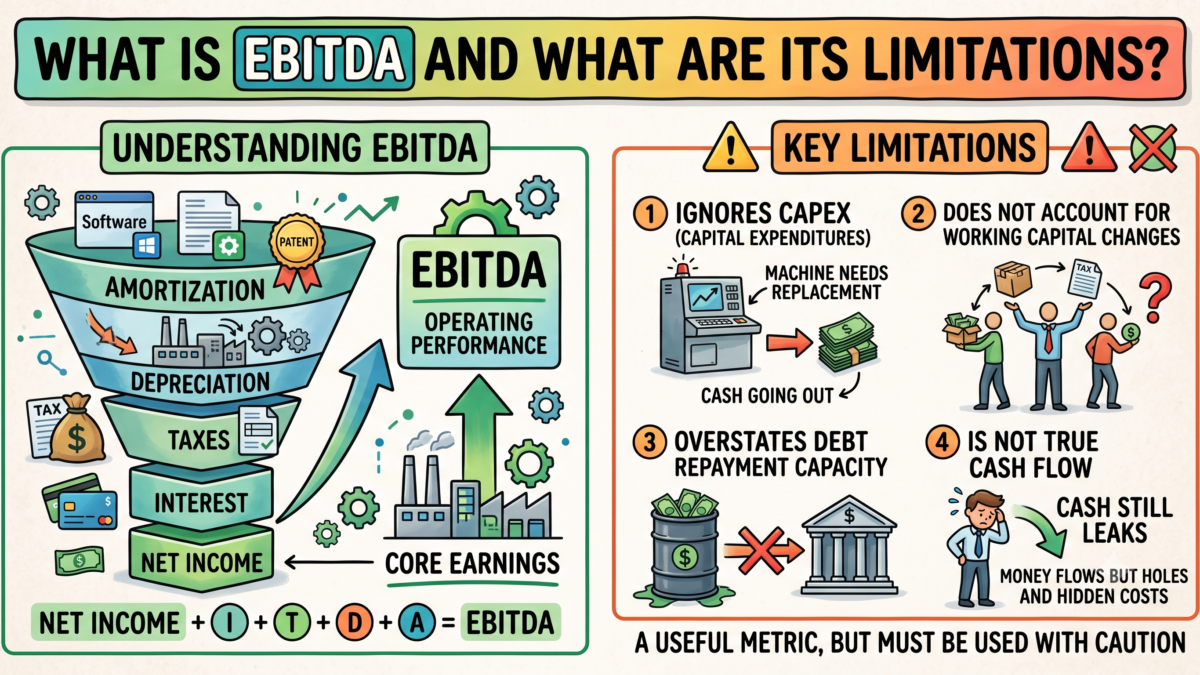
Discover how EBITDA measures core operational earnings, why analysts use it, and the critical limitations every investor must watch for.
Key points
- EBITDA stands for Earnings Before Interest, Taxes, Depreciation, and Amortization, serving as a proxy for operational profitability.
- It allows investors to compare companies across different capital structures, tax regimes, and non-cash accounting methods.
- Major limitations include ignoring capital expenditures (CapEx), debt service costs, and working capital changes.
- EBITDA is not a GAAP or Ind AS standard metric, meaning companies often report customized ‘Adjusted EBITDA’ figures that require close scrutiny.
Understanding What Is EBITDA in Financial Analysis
If you are learning what is ebitda—an acronym for Earnings Before Interest, Taxes, Depreciation, and Amortization—you are looking at one of the most widely used metrics in financial analysis. At its core, EBITDA measures a company’s operating profitability before accounting for financing decisions, corporate tax obligations, and non-cash accounting entries. By stripping out these variable expenses, it provides a clearer view of core operational cash generation.
Financial analysts, private equity firms, and equity investors often rely on this figure to compare businesses operating within the same industry. Because capital structures and regional tax rates vary dramatically between companies, traditional net income can sometimes obscure how efficiently a company’s underlying operations perform.
How EBITDA Is Calculated
There are two primary ways to calculate EBITDA from a standard corporate income statement. Both methods yield the exact same result when applied correctly, though they approach the calculation from opposite ends of the statement.
- Top-Down Approach: Start with Operating Profit (EBIT) and add back Depreciation and Amortization expenses.
- Bottom-Up Approach: Start with Net Income, then add back Interest Expense, Income Taxes, Depreciation, and Amortization.
To see how this works in practice, consider a company reporting $10 million in Net Income, $2 million in Income Taxes, $3 million in Interest Expense, $1.5 million in Depreciation, and $500,000 in Amortization. Adding these components back to Net Income yields an EBITDA of $17 million.
Why Investors Look at What Is EBITDA
When investors examine what is ebitda designed to convey, the primary appeal is comparability. A business funded entirely by equity will have zero interest expense and appear far more profitable on a net income basis than an identical business carrying significant corporate debt. EBITDA normalizes this distinction, letting analysts assess operational strength independently of corporate financing strategy.
Furthermore, EBITDA strips out depreciation and amortization—non-cash expenses tied to historical fixed assets and previous corporate acquisitions. This makes the metric useful for comparing mature firms with young enterprises that carry different asset ages and depreciation schedules.
- Cross-Border Comparison: Eliminates distortion caused by differing state, national, or international tax frameworks.
- Operational Focus: Isolates underlying sales and cost performance from financing choices.
- Valuation Standard: Serves as the foundation for valuation multiples like Enterprise Value to EBITDA (EV/EBITDA).
What Is EBITDA Missing? Major Limitations to Know
Despite its widespread popularity across Wall Street and global financial markets, relying solely on EBITDA can lead to flawed financial conclusions. Renowned value investors have long criticized the metric for ignoring essential cash realities. When analyzing what is ebitda, you must keep its critical limitations in mind.
First, EBITDA ignores capital expenditures (CapEx). Physical assets wear out, software infrastructure requires upgrading, and factories demand ongoing maintenance. Because depreciation is added back, EBITDA creates a false impression of available cash flow by ignoring the actual cash needed to maintain operations. A capital-intensive manufacturing or telecom company might report high EBITDA while spending all its cash on equipment replacement.
Second, EBITDA neglects working capital fluctuations. A company can report strong EBITDA figures while heading toward financial distress if cash remains tied up in unpaid receivables or excess unsold inventory. Third, it completely excludes debt interest and tax payments—mandatory cash outflows that every business must satisfy to stay solvent.
Finally, EBITDA is susceptible to aggressive management adjustments. Companies frequently report customized “Adjusted EBITDA” by adding back legal fees, stock-based compensation, or restructuring costs. Because these adjustments are subjective, they can easily mask structural operating weaknesses.
US vs India Reporting Standards for EBITDA
It is crucial to remember that EBITDA is not a recognized accounting standard under US Generally Accepted Accounting Principles (US GAAP) or Indian Accounting Standards (Ind AS). Consequently, public companies in both the United States and India are not required to present EBITDA on their primary audited financial balance sheets or profit-and-loss statements.
In the United States, the Securities and Exchange Commission (SEC) regulates EBITDA as a “non-GAAP financial measure.” When a US public company includes EBITDA in earnings releases or SEC filings, Regulation G requires them to provide a clear reconciliation to the most directly comparable GAAP metric, usually Net Income or Operating Income.
In India, under guidelines enforced by the Securities and Exchange Board of India (SEBI) and the Ministry of Corporate Affairs, public companies focus primary disclosures on revenue, operating profit (EBIT), and Profit After Tax (PAT). While Indian corporations frequently showcase EBITDA in investor presentation decks, SEBI rules require clear transparency so non-Ind AS measures do not mislead market participants.
Frequently asked questions
Is EBITDA the same as operating cash flow? No. EBITDA does not account for changes in working capital, cash paid for income taxes, or interest payments, whereas cash flow from operations reflects actual net cash generated during the accounting period.
Why is EBITDA widely used in valuation metrics? EBITDA is heavily used in the EV/EBITDA multiple because it allows analysts to evaluate a company’s operating efficiency independent of how the business is capitalized or taxed.
What is Adjusted EBITDA? Adjusted EBITDA modifies standard EBITDA by adding back non-recurring, extraordinary, or non-cash expenses (such as stock-based compensation or severance packages) to reflect normalized earnings.
Can a company report positive EBITDA but negative net income? Yes. A company carrying heavy debt payments, high corporate tax rates, or substantial depreciation costs can easily report a strong positive EBITDA while generating a net loss.
This article is for general education and is not investment, tax or financial advice. Rules and figures change — check the official source or a licensed adviser before acting.
Official information: https://www.sec.gov
This explainer is published by the MoneyPuran desk for general awareness. Rules, limits and rates change over time — please confirm with the official source. Corrections: corrections@moneypuran.com